That first swing and miss at the tee is a rite of passage. It’s both heartwarming and hilariously awkward. You see the spark, the pure joy of the game. But the journey from that chaos to a smooth hit is like a secret map.
Is it just grinding out drills until something clicks? Hoping for a growth spurt? Finding the mythical perfect coach?
We see it differently. At the RoughRiders, we’ve broken down the baseball journey like a strategist dissects a championship play. This isn’t about luck or vague hope. It’s a deliberate, analytical system built on clear development stages.
Think of it less like random practice and more like leveling up in the world’s best video game. The rewards aren’t virtual points. They’re real confidence, sharp coordination, and a deeper love for the sport.
We’re here to show you that map. Let’s chart the course from enthusiastic beginner to composed competitor. We’ll highlight the key skill milestones we track and the smart philosophy that makes it all work.
The RoughRiders Progression Ladder (Levels 1–5)
The RoughRiders system is simple yet bold: baseball development should be measured in skills, not birthdays. We’ve ditched the vague “he’s getting better” feedback. Instead, we’ve created a five-tier competency pyramid. It’s not about age. It’s about what you can do.
Think of it like earning badges in scouting or leveling up in a video game. Each promotion is earned. Each level has clear exit criteria. Moving up means you’ve mastered specific, observable skills. The ladder creates a roadmap. It turns abstract improvement into tangible achievement.
Let’s break down what each rung on this ladder actually means for a young player’s journey.
| Level | Theme & Nickname | Primary Focus | Key Benchmark | Player Mindset |
|---|---|---|---|---|
| Level 1 | Fundamentals Bootcamp | Building the kinetic chain. Basic throwing motion. Consistent tee contact. Running through first base. | Can execute a basic, repeatable throwing sequence to a partner 30 feet away. | “I am learning what this sport is.” |
| Level 2 | Skill Application | Using fundamentals in simple drills. Catching a softly thrown ball. Hitting a moving pitch. Basic base running rules. | Successfully fields 7 out of 10 ground balls in a controlled drill and makes an accurate throw. | “I can do the drills. Now what?” |
| Level 3 | Game Integration | Applying skills in live, low-pressure situations. Reacting to game scenarios. Understanding positions. | Makes the correct base running decision (hold or advance) on a hit to the outfield 80% of the time. | “I see how the pieces fit together in a game.” |
| Level 4 | Strategic Play | Advanced mechanics and anticipation. Hitting to all fields. Making the routine play consistently. Relaying throws. | Can intentionally hit a line drive to the opposite field during batting practice. Makes the cut-off throw instinctively. | “I’m not just playing; I’m thinking ahead of the play.” |
| Level 5 | The Artisan | Mastery and leadership. Plays become instinctual. Adjusts mechanics mid-at-bat. Leads by example and communication. | Executes a difficult backhand play and makes a strong, accurate throw to the correct base without hesitation. | “The game has slowed down. I can create within it.” |
Notice the progression? Level 1 is about awareness of the body and the ball. Level 2 adds consistency. Level 3 introduces context—the game itself. Level 4 demands strategy and intention. Level 5? That’s where baseball development becomes artistry. The player isn’t just reacting. They’re creating.
The complexity—and frankly, the fun—ramps up at each stage. A Level 3 player experiences the thrill of their first clean double play. A Level 5 player feels the satisfaction of calling a defensive shift that actually works. The challenges evolve. So does the reward.
This ladder creates clarity for everyone. Coaches know exactly what to teach next. Parents see concrete milestones. Most importantly, players understand their own growth. They’re not chasing a vague idea of “better.” They’re mastering specific skills to unlock the next level of the game. That’s the heart of true baseball development.
Core Competencies by Level (Throw/Field/Hit/Run)
Forget vague praise about ‘getting better’—our system defines improvement with surgical precision across four core competencies that separate rookies from all-stars. We’ve dissected baseball like a forensic analyst at a crime scene, leaving no mystery about what constitutes real progress.
Think of this section as your decoder ring. It translates coach-speak into a clear picture of where your player excels and where the next breakthrough awaits. No more wondering if ‘good arm’ means he can hit the cutoff man or just hasn’t broken a window yet.
Our progress reports are brutally specific. We don’t deal in participation trophies or generic encouragement. We measure what matters. Below is your roadmap from ‘just starting’ to ‘game-changer.’
The Throw: From Directional to Dominant
At Level 1, a ‘good’ throw means it generally goes toward the intended teammate. By Level 3, we demand a four-seam fastball with clean backspin and accuracy to a chest-level target from 60 feet. The evolution isn’t subtle.
| Level | Throw Benchmark | What We Measure |
|---|---|---|
| 1 (Rookie) | Directional accuracy | Does it go toward the target? |
| 2 (Developing) | Basic arc and consistency | Can they repeat a throw 7/10 times? |
| 3 (Intermediate) | Four-seam grip, backspin, 60ft accuracy | Spin rate, release point, chest-high strikes |
| 4 (Advanced) | Velocity + accuracy from outfield | MPH on gun, hitting cutoff on line |
| 5 (All-Star) | Precision throws under pressure | Pickoff moves, throwing runners out, situational arms |
The Hit: Beyond Batting Average
We don’t just count hits. We chart contact quality—soft, medium, or hard—like a sommelier describing wine. Pitch recognition and two-strike approach matter more than a lucky blooper over the shortstop’s head.
Our progress reports break down swing mechanics, pitch selection, and competitive at-bats. A Level 5 hitter isn’t just powerful; they’re a tactician who spoils good pitches and punishes mistakes.
The Field: First Step to Fluid Transfer
Fielding isn’t about flashy grabs. It’s about first-step quickness, glove presentation before the ball arrives, and the fluidity of the transfer from glove to hand. We watch feet before we watch hands.
A Level 1 fielder stops the ball. A Level 3 fielder creates their own hop. A Level 5 fielder makes the difficult look routine and turns double plays like a metronome. Our assessments track this silent efficiency.
The Run: More Than Raw Speed
Running isn’t just the 60-yard dash time. It’s lead-offs, secondary leads, reading pitchers, and baserunning IQ. Knowing when to take the extra base is worth more than pure speed.
| Skill Component | Level 1-2 Focus | Level 3-5 Focus |
|---|---|---|
| Leads & Secondary | Not getting picked off | Gaining optimal distance, reading move |
| Base Running | Remembering base order | Reading ball in air, hitting inside corner |
| Sliding | Basic pop-up slide | Hook slide, avoiding tags, speed slides |
This granular approach transforms feedback from “needs to work on defense” to “needs to improve first-step quickness on grounders to the backhand.” Suddenly, practice has purpose. The next breakthrough becomes visible, not vague.
Your player’s progress reports will map their journey across these four pillars. You’ll see exactly where they stand—not just compared to others, but compared to their full capacity. It’s the difference between hoping they improve and knowing how to make it happen.
Mechanics Benchmarks & Video Feedback
In the RoughRiders program, we treat mechanics like forensic evidence, not folklore. Telling a player to “keep your eye on the ball” is vague and frustrating. It’s like asking a detective to “just find the culprit” without any clues.
We need specifics. We need data. We need mechanics benchmarks—clear, measurable standards for every fundamental movement. This turns vague advice into concrete, achievable targets.
Think of it as building a blueprint for athletic success. Instead of guessing, we establish video benchmarks for three core movements:
- The Hip-Shoulder Separation in a Swing: This isn’t about power; it’s about physics. We measure how many degrees your upper body coils against your lower. Improving this by even 5 degrees is a tangible skill milestone that directly translates to bat speed.
- The Long-Toss Arc of a Throw: Arm strength isn’t just about muscle. It’s about the efficient, parabolic path of the ball. We film throws to analyze the arc’s consistency and height. A smoother, more repeatable arc equals better velocity and less strain.
- The Fielding Triangle Stance: Ground balls aren’t won with heroic dives; they’re won with prepared positioning. We benchmark the ideal “ready” stance: feet shoulder-width, knees bent, hands out. It’s the foundation for every clean play.
This is where our side-by-side video feedback becomes the game-changer. We don’t just show a player their swing. We show it next to a model swing from a month ago, or next to a pro’s mechanics. The comparison is objective and undeniable.
Seeing your current bat path laid over your old one is powerful. It turns the feeling of “I’m swinging late” into the fact of “My hands are starting 0.2 seconds later.” This visual evidence cuts through frustration faster than any pep talk. It makes coaching points stick because the player sees the problem and the solution.
Our approach is tech-light but insight-heavy. We’re not a NASA lab. We use iPads, simple camera angles, and a coach’s analytical eye. The goal isn’t to overwhelm with data but to enlighten with evidence.
This process turns intangible feelings into visible progress. That 5-degree improvement in your bat path? That’s a documented skill milestone. The more consistent long-toss arc? Another skill milestone checked off. These aren’t participation trophies; they’re forensic reports on your growing ability.
The result is motivation you can measure. When a player can physically see their mechanics improving, it validates the hard work. It transforms practice from a chore into a series of solvable puzzles. “I feel off” becomes “I see my front shoulder is flying open,” which immediately becomes “I know how to fix it.”
This isn’t magic. It’s methodology. By giving players and parents clear, visual benchmarks, we replace hope with strategy and guesswork with growth. Every frame of video becomes a stepping stone toward the next major skill milestone.
Baseball IQ: Situational Awareness & Rules
Baseball isn’t played in a weight room or a batting cage. It’s played on a chessboard. Even with a great swing, being a liability on the field is common. This is because baseball development is 50% physical skill and 50% mental mastery.
Our Baseball IQ curriculum is where we separate players from athletes. It’s the operating system that runs the hardware.
At lower levels, questions are simple. “Where’s the play on a grounder with no runners on?” “Which base do you throw to?” We build awareness, one brick at a time.
By Level 4, the questions get tougher. We dive into first-and-third defensive schemes, bunt coverages, and hitting behind the runner. It’s about understanding the why behind each action.
Why take a pitch on a 3-0 count? It’s not just a rule. It’s a strategic gift from a struggling pitcher. Why throw through the cutoff man in some situations but hit him in others? It’s a calculated risk based on the runner’s speed and the game’s score.
We use film as our textbook. Sessions break down MLB plays and our own games. We turn mistakes into lessons and brilliant plays into blueprints. “See how the shortstop cheated two steps toward second? That’s anticipation.”
The goal isn’t to create robots who memorize scenarios. It’s to cultivate players who think the game. Players who see two moves ahead. This mental baseball development transforms reaction into anticipation. It turns a good athlete into a savvy player.
In the end, the game rewards the thinker. It’s chess in cleats. And every great checkmate starts with understanding the board.
Confidence, Leadership, and Team Habits
Our progress reports have a secret section that coaches talk about but rarely share numbers on. They focus on the character of the players. Batting averages and ERA numbers are important, but they’re not everything. It’s the team’s culture that truly matters.
What happens off the field is just as important as what happens on it. Does a player pick up the batting tee without being told? That shows they’re part of the team. Do they support their teammates, even when things go wrong? That’s leadership and confidence in action.
We see these traits as skills that can be learned, not just natural talents. We practice them in low-pressure situations to build resilience. Leadership is not just about being in charge; it’s about leading by example.
Baseball often sees players with great talent but lack confidence. Our approach is simple: a player with confidence and support will do better than one who is technically skilled but fragile. The game reveals a player’s true character quickly.
We’ve created a way to track these important qualities. It turns what coaches whisper about into data.
| Trait | Observable Behavior | Progress Report Metric | Developmental Drill |
|---|---|---|---|
| Confidence | Body language after mistake; willingness to try again. | Reset Time Score (1-5 scale) | “Error & Reset” Simulation: Immediate do-over after a booted ground ball. |
| Leadership | Verbal encouragement; helping a teammate adjust grip. | Teammate Impact Rating | Captain’s Warm-Up: Player designs and leads pre-practice routine. |
| Team Habits | Equipment care; helping without being asked; punctuality. | Responsibility Index | Clean-Up Crew Rotation: Assigned team manages gear post-session. |
| Composite | Overall intangible impact on team culture and morale. | Character Growth Score | Leadership Scenarios: Low-pressure game situations where player must direct peers. |
The Reset Time Score shows how quickly a player bounces back from a mistake. It’s a measure of resilience. The Teammate Impact Rating comes from feedback from teammates. They notice who lifts them up.
This isn’t just about feeling good. It’s about winning. A team that takes care of its equipment is a team that pays attention to details. A player who supports their teammates builds loyalty and trust.
Our final reports don’t just show batting stances and footwork. They show the making of a ballplayer’s backbone. In the late innings, when stats don’t matter, character does.
Mid-Camp and Final Assessments (what’s measured)
Our assessment days are like a presidential debate for baseball. Everyone’s skills are measured and scored. But, unlike debates, we see real progress.
Twice a cycle, we switch from casual drills to precise metrics. This is because “getting better” should be proven, not just felt.
The Mid-Camp Assessment is like a halftime check-in. It helps us see if players are on track and if we’re focusing on the right areas. It’s not about judging, but about making adjustments.
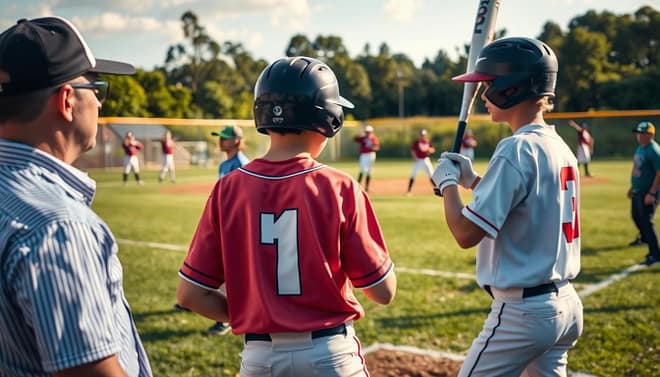
The Final Assessment is the final verdict. It covers everything from numbers to mechanics. Together, they paint a complete picture of a player’s abilities.
So, what do we measure? Here’s a breakdown:
| Quantifiable Metrics | Qualitative Evaluations | Assessment Method |
|---|---|---|
| Throw velocity (mph) | Mechanics efficiency | Radar gun + coach rubric |
| Exit velocity off tee | Baseball IQ decisions | HitTrax system + scenario testing |
| 60-yard dash time | Team habits & communication | Laser timing + observational scoring |
| Fielding success rate | Leadership demonstration | Stations with repetition tracking |
Players go through stations like a mini-combine. Each coach uses a specific rubric to score. It’s not about passing or failing, but about tracking progress.
This method removes guesswork and focuses on facts. It turns vague comments into specific feedback. We use tools like a measurement guidance toolkit for consistency. Every evaluation is tied to skill milestones that can be observed.
Parents and players leave with clear insights. They celebrate strengths and know exactly what to work on next season. No more wondering what the coach really thinks. The data is clear.
Our assessments turn vague improvement into focused development. They show the path from where you are to where you want to be. Isn’t that the goal?
Personalized Goal Sheets & Home Plans
Let’s be honest. “Work harder” and “get better” are empty promises in sports advice. They sound good but mean nothing and leave everyone frustrated. We see this often: a player gets a data-rich diagnosis but leaves with no clear plan.
After analyzing a player’s mechanics, IQ, and habits, we have a key conversation. We co-create a Personalized Goal Sheet. This isn’t just a coach’s order. It’s a team effort where the player is fully involved.
We focus on specific goals. Forget vague advice like “improve your arm strength.” Try: “Increase long-toss distance from 120 feet to 150 feet by July 15th.” This makes goals clear and achievable.
Here’s what that looks like in the wild:
- Throw: “Use a towel to drill the high-elbow position for 10 minutes, 3x a week.” (Yes, your laundry is now a baseball development tool.)
- Field: “Practice backhand glove flips against a wall for 50 reps daily to clean up transfer time.”
- Hit: “Focus on keeping your front side closed during tee work, using a chair as a physical barrier.”
- Run: “Improve 60-yard dash time by 0.2 seconds through explosive starts from a crouch position.”
This sheet is the diagnosis. The Home Plan is the treatment. It’s a detailed plan for practice at home. We give drills, reps, and hacks using everyday items.
A towel isn’t just a towel; it’s a tool for checking arm path. A wall isn’t just a wall; it’s a fielding partner.
We’re not just running a clinic. We’re teaching families to help in the player’s growth. This makes practice clear and manageable. It turns “I should go work out” into a daily routine.
The goal sheet is a contract with oneself. The Home Plan is the daily work to meet those goals. This is where real growth happens, one specific rep at a time.
Parent-Teacher-Player Conferences (PTP)
Forget the dreaded parent-teacher conference of your school days; ours come with a game plan, not a guilt trip. We’ve borrowed the academic model’s best feature—structured feedback—and left the anxiety at the door. The RoughRiders PTP is a strategic huddle.
This is a three-way conversation. The coach, the player, and the parent. Each has a distinct role, and when they sync up, real development accelerates.
The coach’s job is to present the facts. We bring the assessment data, the video clips, and the detailed progress reports. It’s not about judgment. It’s about showing the map of where the player is and the terrain ahead.
The player’s role is the most transformative. They learn to articulate their own experience. What felt good this season? What’s frustrating? What’s one goal that gets them excited? This isn’t just sports talk. It’s a life skill—learning to advocate for yourself and analyze your own performance.
The parent becomes the ultimate strategic ally. Your job is to listen, ask sharp questions, and help connect the dots. You’re not there to speak for your player, but to empower them. Think of yourself as the board member providing support and resources for the CEO (that’s your kid).
So, how do you prepare for this? Come ready to collaborate, not confront.
- For Players: Think of one thing you’re proud of and one thing you want to tackle next. Be ready to say it out loud.
- For Parents: Your questions are gold. Ask about process, not just outcomes. “What’s the next micro-skill he should focus on?” or “How can we support the practice habit at home?”
- For Everyone: The goal is alignment. We’re making sure all three parties are reading from the same playbook for the next chapter.
These conferences turn data into dialogue and dialogue into a clear path forward. They ensure everyone understands the progress reports and is committed to the same next steps. It’s where assessment meets action.
When to Move Up a Level
Every youth baseball program wonders about promotions. It’s like watching a pop fly in the sun, with everyone looking but unsure where it will land.
Moving up isn’t automatic or random. It’s like getting a security clearance. You must show you’re ready for the next level’s challenges.
Our rule is simple but requires careful thought. A player must master 80% of their current level’s skills. This means doing it all the time, not just when the coach is watching.
Then, they must show they can do the next level’s skills in practice. It’s not about hitting a home run once. It’s about consistently showing they belong with the big kids.
We’re careful to avoid the “big fish, small pond” problem. Promoting a player too early can hurt their confidence. They might struggle to keep up and develop bad habits.
On the other hand, holding back a player who’s ready can make them bored and stagnant. They might stop trying because there’s nothing left to prove.
We have a “coach council” to make decisions. Every coach who knows the player shares their thoughts. We look at all the data, like mid-camp evaluations and video feedback.
Tracking skill milestones is key. We’re not just looking at wins. We’re checking if the player is ready for more challenges.
The decision is about the player’s future, not just this season. That’s the part that requires backbone. We’ve seen parents and coaches push for promotions for the wrong reasons.
It’s not about winning games or trophies. It’s about building a player who loves the game and is skilled enough to succeed.
When a player consistently hits their skill milestones and shows a love for learning, we take notice. We watch for that spark in their eyes when they face tough competition.
Our system helps guide us, but we make the final call. We ask if the promotion will make the player better in three years. If not, we wait. The skill milestones show what’s possible, and our experience tells us when it’s time.
Tracking Progress Across Seasons
Tracking a young athlete’s progress shows the real beauty of growth. It’s not about building robots. Our system looks at more than just one summer.
Think of it as a player portfolio. Each season adds new data, telling a bigger story. This long view shows true baseball development.
Now, a three-week hitting slump doesn’t worry you as much. You see a two-year chart showing steady growth. You understand how a player’s strikeout rate dropped after we changed their two-strike approach.
This big-picture view is key. It turns a tough season into a chance to learn and grow. Kids go through ups and downs, like growth spurts and mental blocks.
Our system shows that the hard work pays off over time. It’s a smart answer to the “what have you done for me?” question in sports.
Here’s what we track across seasons:
- Skill Velocity: We look at how their power and contact rates change over years.
- Baseball IQ Growth: We see how their decision-making in drills improves.
- Mechanical Consistency: We find out which flaws keep coming back and which fixes stick.
We use this data to make smart changes. If a player’s throwing accuracy stalls, we try a new approach. Maybe it’s a vision problem, not a mechanics issue. If their speed hasn’t improved, we check their strength training or running form.
This data celebrates long-term growth. It turns baseball development into a meaningful story. Kids see their own growth from shaky throws to confident command.
Parents stop focusing on monthly improvements. They start thinking about the big picture. This mindset shift builds resilience and teaches patience.
In conferences, we review the long-term progress, not just the last assessment. We show where the real breakthroughs happened, often months later.
Our advice is simple: judge progress in years, not weeks. The portfolio shows that the process works, even when results aren’t immediate.
True baseball development is about a story you’ll be proud of in five years. Our system gives you the tools to write that story. Just keep showing up to write the next chapter.
Next Steps: Clinics, Leagues, Private Lessons
So the final whistle blows on assessment camp. The data is in. What’s the next play?
Think of your final progress reports as a strategic compass. They don’t just show where you are. They point to the most efficient route forward. We analyze these documents like a coach breaking down game film.
Does the player need the repetitive, skill-specific drilling of a specialized clinic? Our infield defense or two-strike hitting clinics offer that laser focus. Is it time to test refined mechanics at game speed? Our controlled RoughRiders leagues provide that authentic pressure cooker. Or is there one stubborn mechanical flaw needing a surgeon’s precision? That’s where our private lessons excel.
We’re not a car dealership trying to upsell every feature. We’re your strategic advisor in cleats. The right next step depends entirely on the evidence in those progress reports.
The journey from rookie to all-star is a marathon. We just handed you the map for the next mile. Your progress reports tell us whether you need a water station, a pace car, or a new pair of shoes. Let’s run the next leg together.