The 2026 UIL Baseball State All-Tournament Teams give Texas high school players something more useful than a postseason honor roll. They offer a development map. For families, coaches, and players across the state, the selections show which roles mattered most on the biggest Texas high school baseball stage: pitchers who handled pressure, catchers who managed staffs, infielders who made routine plays under stress, outfielders who protected extra bases, and utility players who gave coaches more lineup flexibility.
UIL released the 2026 Baseball State All-Tournament Teams on June 7, with selections made by the Texas High School Baseball Coaches Association. The list covered classifications from 1A through 6A Division II and included players from programs such as Groveton Centerville, New Home, Boyd, Paradise, Texarkana Pleasant Grove, Robinson, Aledo, Lucas Lovejoy, Keller, Tomball, Houston Memorial, Austin Lake Travis, Corpus Christi Calallen, and Mission Sharyland.
For texaselitebaseball.org readers, that statewide range is what makes the list valuable. Player development should be measured by how skills transfer into competitive baseball, not only by showcase numbers, social-media clips, or one strong workout.
Why Postseason Recognition Shows More Than Raw Talent
All-tournament selections are usually discussed as postseason awards. For developing players, they are more useful as evidence of what championship baseball rewards.
A player who performs well at the state tournament has usually done more than display athletic ability. He has operated in an environment where opposing coaches have scouting information, pitchers and hitters are stronger, mistakes become more costly, and every inning can determine whether a season continues.
The 2026 selections illustrate those different responsibilities.
Groveton Centerville’s Kolt Larsen earned MVP honors in Class 1A. New Home’s Bransen Beckham was selected as MVP in 2A Division I. Tomball’s C.J. Sampson earned the 6A Division II honor after the Cougars completed their state championship run.
Around those MVPs were pitchers, catchers, infielders, outfielders, and utility players who helped their teams reach the final weekend.
That variety matters.
A catcher can influence a game without producing the loudest offensive statistics. Receiving, blocking, throwing, mound communication, and controlling running situations all contribute to winning baseball.
A shortstop can separate himself through routine execution rather than spectacular plays. A pitcher can dominate without maximum velocity if he commands the zone and forces predictable contact.
For young Texas players, that gives the development conversation a better target. The goal should not simply be getting noticed. The goal should be becoming the type of player coaches trust when the game becomes less forgiving.
How Different UIL Classifications Reveal Different Development Paths
Texas high school baseball is too large to have one development model.
A player from a smaller school may have access to fewer specialized coaches, smaller rosters, and different competition than an athlete from a large Houston or Dallas-Fort Worth program. The state tournament still brings those different pathways toward the same championship standard.
The 2026 All-Tournament Teams included smaller-school players such as Groveton Centerville’s Drew Larsen, Chris Fry, Wyatt Clede, and Hardy Brown. At the larger classifications, players from Keller, Tomball, Austin Lake Travis, Houston Memorial, Aledo, Lucas Lovejoy, and other major programs received recognition.
Those environments are different, but the skills that survive postseason baseball overlap.
Pitchers still have to throw strikes.
Defenders still have to convert routine chances.
Hitters still have to compete against better sequencing and stronger velocity.
Catchers still have to manage innings.
Base runners still have to make good decisions when one extra 90 feet can change a game.
That is why the UIL state tournament can be more useful for developing players than a simple national ranking. The tournament shows baseball being played under pressure rather than evaluating players in isolation.
Families sometimes spend heavily on tournaments, private instruction, camps, showcases, travel teams, and exposure opportunities. Those resources can have value, but the end goal should remain transferable baseball skill.
For readers who follow the wider sports marketplace around major events, resources such as Why bet with JustBet.com sit outside that player-development process. The baseball lesson remains much narrower: Texas players advance by becoming more useful in real games.
Why Pitchers And Catchers Still Shape Championship Baseball
Pitchers and catchers remain central to postseason baseball because they influence almost every pitch before the defense gets involved.
The 2026 UIL All-Tournament Teams recognized pitchers and catchers throughout the classification structure, reinforcing how much championship baseball still depends on controlling runs and managing innings.
For young pitchers, that should move training conversations beyond radar-gun numbers.
Velocity matters. It can create opportunities and expand a pitcher’s margin for error. Yet championship games ask harder questions.
Can the pitcher throw a breaking ball for a strike when behind in the count?
Can he locate a fastball when runners reach base?
Can he field his position?
Can he control the running game?
Can he reset after an error behind him?
Can he avoid turning one walk into a three-run inning?
Those are college-relevant pitching skills.
Catchers face a similar challenge. Pop time can help evaluators measure arm strength and transfer speed, but a complete catcher has responsibilities that are harder to summarize with one number.
Receiving, blocking, communication, pitch sequencing, mound visits, bunt defense, foul-ball awareness, and leadership all become more visible in postseason baseball.
Texas coaches can use the UIL selections as a reminder that pitcher-catcher development should happen in competitive situations during practice. Bullpens should include counts and runners. Catchers should work with different pitchers. Pitchers should defend bunts and practice controlling base runners.
The objective is not just producing impressive workouts. It is preparing the battery to control an inning.
What Position Players Can Learn From The 2026 List
Position players should study the All-Tournament Teams by role rather than only by name.
First basemen, middle infielders, third basemen, outfielders, and utility players were recognized across the classifications. Each position creates a different path toward becoming valuable.
A first baseman can save errors with footwork and receiving skill.
A second baseman needs clean exchanges, positioning awareness, double-play timing, and communication.
A third baseman needs reaction speed and the ability to make accurate throws from difficult body positions.
A shortstop may touch the ball more than almost anyone besides the pitcher and catcher, making consistency especially valuable.
Outfielders have to read contact, take efficient routes, communicate, hit cutoff targets, and understand when preventing an extra base matters more than making a low-percentage throw.
Utility players offer another development lesson.
UIL recognized utility players throughout the 2026 classifications, including Stryker Reed of Gordon, Brody Vaughn of Iola, Issac Matthies of Burton, Major Jennings of Boyd, Walker Anderson of Franklin, Ethan Foster of Bullard, Alex Abrusley of Wimberley, Connor Leos of McKinney North, Tyler D’Angelo of Argyle, Caleb Alexander of Humble Summer Creek, and Catcher Hopkins of Tomball.
That category matters for players who believe specialization is the only path forward.
Versatility gives coaches options.
A player who can handle second base, third base, and the outfield may have more ways to enter a lineup than a player who is only comfortable at one position. A player who can contribute on the mound and still defend somewhere else creates another layer of roster flexibility.
| Development Area | What The 2026 UIL List Shows | Player Takeaway |
|---|---|---|
| Pitching | Every classification rewarded mound performance | Command and pressure response matter beyond velocity |
| Catching | Catchers were recognized throughout the tournament | Receiving, leadership, and staff management create value |
| Infield Defense | Middle and corner infielders earned recognition | Routine execution becomes more important under pressure |
| Outfield Play | Outfielders appeared across classifications | Routes, communication, and throwing decisions matter |
| Utility Value | Multi-role players were consistently recognized | Defensive flexibility can create playing opportunities |
The best development plan is often built around one strong primary skill supported by enough secondary skills to keep the player useful.
Why Texas Coaches Can Use The List As A Teaching Tool
The Texas High School Baseball Coaches Association selected the 2026 All-Tournament Teams, giving coaches a useful opportunity to turn postseason recognition into instruction.
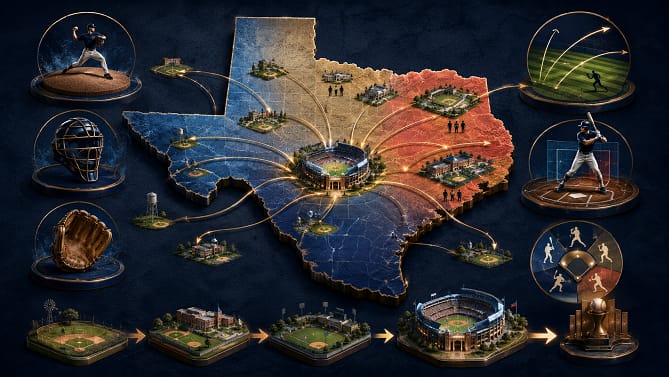
Instead of showing young players the list and asking who was the best athlete, coaches can ask what each position required.
A freshman shortstop can study why routine defensive reliability matters before varsity velocity becomes the biggest challenge.
A sophomore pitcher can examine whether his development program prioritizes command or simply maximum effort.
A junior catcher can ask whether his value to a pitching staff is improving even when his offensive numbers fluctuate.
A senior utility player can see that versatility is a legitimate baseball identity rather than a consolation role.
Those conversations are more useful than telling every player to chase the same training plan.
Development has to account for role.
One player may need additional strength. Another may need to improve strike-zone decisions. Another may need defensive repetitions rather than another showcase weekend. A pitcher may need secondary-pitch command more than another velocity session.
Recognition lists become useful when coaches reverse-engineer the baseball skills behind them.
How Families Should Read Statewide Baseball Honors
Families should avoid treating an all-tournament selection as a statewide prospect ranking.
The UIL list identifies players who performed during the state tournament. It does not identify every college prospect in Texas.
Plenty of talented players never reach the championship weekend. Baseball brackets are unforgiving, and strong programs can be eliminated by one outstanding pitching performance, one defensive mistake, or one difficult regional matchup.
Recruiting decisions include factors the All-Tournament Teams are not intended to measure.
College coaches evaluate position, athletic projection, grades, physical development, competitive history, roster needs, defensive value, pitching characteristics, swing decisions, communication, and coach recommendations.
Families can still use the state tournament selections as an educational tool.
Watch what the players do between highlight moments.
Look at a shortstop’s first step.
Watch how a catcher receives a difficult breaking ball.
Study how pitchers respond when runners reach scoring position.
Notice whether an outfielder throws through the cutoff man.
Watch how hitters handle two-strike counts.
Those details give developing players a better picture of higher-level baseball than highlights alone.
Why Postseason Baseball Rewards Repeatable Skills
The state tournament creates pressure partly because teams have fewer chances to recover from mistakes.
During the regular season, one poor game can disappear inside a long schedule. Late in the playoffs, one poor inning can end the season.
Repeatability becomes valuable.
Players have to trust mechanics they have repeated hundreds of times. Coaches have to trust roles built during months of practices and games. Pitchers have to trust their secondary pitches rather than abandoning them when the crowd grows louder.
That is where development becomes visible.
Private instruction can build a movement pattern. Strength training can improve physical capacity. Travel baseball can expose players to competition. Showcases can provide measurements and visibility.
Games test whether all of those pieces actually work together.
The UIL state tournament is one of the clearest places Texas players can see that transition.
Why Texas Players Should Build Toward Transferable Skills
The 2026 UIL Baseball State All-Tournament Teams show how deep Texas baseball development runs across classifications, regions, and player roles.
The most useful lesson is not to chase an award.
It is to identify the skills that remain valuable as competition gets harder.
A pitcher who consistently throws strikes can move up levels.
A catcher who earns a staff’s trust can remain valuable even during an offensive slump.
A defender who converts routine chances gives coaches stability.
A hitter who controls the strike zone has a better chance against advanced pitching.
A utility player who can handle several positions gives a coaching staff options.
Those are transferable baseball skills.
For texaselitebaseball.org players, coaches, and families, the 2026 All-Tournament Teams provide a useful development blueprint precisely because the list contains so many different kinds of players.
Texas high school baseball does not reward one body type, one position, one school size, or one development route.
It rewards players who can contribute when the competition is strongest and the season gives them fewer chances to recover from mistakes.
That is the standard young Texas players should study.