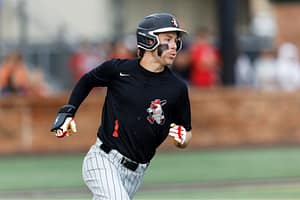
The 2026 UIL Baseball State Tournament gave Texas high school baseball families more than a three-day championship finish in Round Rock. It showed how deep the state’s development pipeline has become across classifications, regions, coaching styles, and roster models. From New Home opening the finals in 2A Division I to Tomball closing the weekend with a 6A Division II title, the event offered a clear view of how Texas programs prepare players for pressure long before they reach Dell Diamond.
For texaselitebaseball.org readers, the useful takeaway is developmental. State tournament teams do not arrive in Round Rock by accident. They are usually built through pitching depth, defensive consistency, physical preparation, player buy-in, and a year-round training standard that starts well before the postseason bracket sharpens. UIL’s official tournament information placed the 2026 state event at Dell Diamond in Round Rock from June 4-6, with championship games across 1A through 6A divisions, giving players and families a statewide snapshot of what high-level Texas baseball requires at different school sizes through the UIL baseball state tournament.
Why Round Rock Became A Statewide Development Snapshot
The 2026 tournament schedule showed the range of Texas baseball in one concentrated setting. New Home, Burton, Boyd, Paradise, Texarkana Pleasant Grove, Robinson, Aledo, Lucas Lovejoy, Groveton Centerville, Keller, Austin Lake Travis, Tomball, and Houston Memorial all appeared in the championship weekend picture. That mix matters because it pushes the conversation beyond one recruiting hotbed or one suburban power.
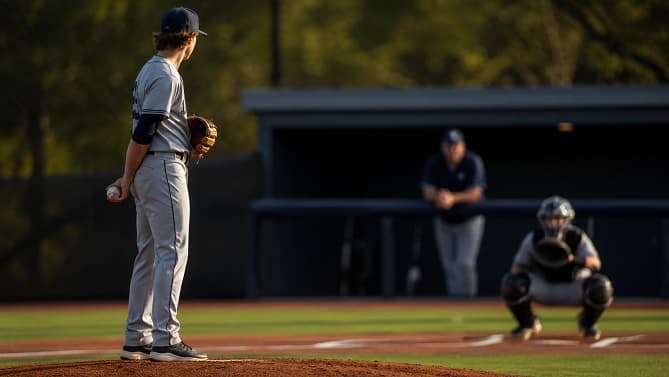
A smaller-school finalist may not have the same roster size as a 6A program, but the developmental questions are similar. Can the team throw strikes under pressure? Can the defense make routine plays when every mistake feels larger? Can hitters handle velocity, spin, and game pressure without turning at-bats into panic swings? Can coaches manage arms, travel, weather delays, and player emotion across a championship week?
Those are college-style questions showing up inside the high school game. Players who want to advance need to understand that development is not only a private lesson or a showcase metric. It is the ability to carry skill into a game that has stakes, pace, scouting attention, family pressure, and a tighter margin for error.
That is why the Round Rock setting matters. Dell Diamond gives the tournament a professional-feeling stage, but the baseball lesson is still local. The players who perform there were shaped by Texas school programs, summer teams, strength rooms, family sacrifice, and coaching routines.
How Multiple Classifications Reveal Different Player Pathways
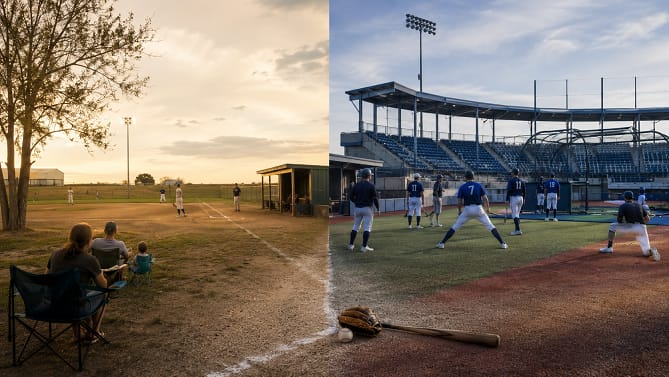
One of the strengths of the UIL tournament is that it does not tell one story about Texas baseball. The 2A and 3A finals show how smaller communities can produce tough, polished, competitive teams. The 5A and 6A finals show what happens when larger programs combine depth, athleticism, and specialized roles. Both paths matter.
The 2026 finals results reinforced that range. New Home beat Iola 7-2 in 2A Division I, Burton beat Ropes 6-1 in 2A Division II, Boyd edged Corpus Christi London 9-8 in 3A Division I, and Paradise beat Franklin 9-0 in 3A Division II. Later in the weekend, Texarkana Pleasant Grove beat Corpus Christi Calallen 2-1 in 4A Division I, Robinson beat Brock 3-1 in 4A Division II, Aledo beat Montgomery Lake Creek 3-1 in 5A Division I, Lucas Lovejoy beat Mission Sharyland 7-2 in 5A Division II, Groveton Centerville beat Gordon 2-0 in 1A, Keller beat Austin Lake Travis 2-1 in 6A Division I, and Tomball beat Houston Memorial 9-1 in 6A Division II.
Those scores show different game shapes. Some finals were tight, low-scoring tests of pitching and defense. Others demanded offensive answers and bullpen resilience. That variety is valuable for player development because no single baseball profile wins every bracket. Texas players need more than one tool. A hitter needs approach. A pitcher needs command. A defender needs reliability. A catcher needs leadership. A bench player needs readiness.
Families can connect that lesson to a broader Texas high school baseball pathway, where the jump from high school success to college readiness depends on repeatable habits rather than one strong weekend.
Why Pitching Depth Still Separates Contenders
The UIL tournament is a strong reminder that pitching depth is not a luxury. It is often the separator between a good team and a state-ready team. Championship baseball compresses pressure. Teams must survive playoff series, manage arms responsibly, recover between games, and face lineups that punish missed locations.
That is a major lesson for young Texas players. Velocity can open doors, but command keeps pitchers in big games. A high school arm who wants to move toward college baseball has to do more than throw hard in a bullpen. He has to hold runners, field his position, execute two-strike pitches, manage innings after defensive mistakes, and trust a game plan when adrenaline is high.
The same applies to position players. A team with one dominant arm can win plenty of games. A team with multiple usable arms, reliable defense, and hitters who can win different types of at-bats has a better chance to survive a full postseason path.
UIL’s championship weekend also had practical pressure around schedule management. The official broadcast page noted that the 2026 championships were streamed by the NFHS Network from Thursday, June 4 through Saturday, June 6 at Dell Diamond, giving families, alumni, and player-development audiences a way to follow every title game through the UIL championship broadcast. That visibility adds another layer to the development test. Players are not only competing; they are doing it on a public stage.
What Tomball And Keller Showed At The Top Classification Level
The 6A results gave the tournament its sharpest large-school development example. Keller beat Austin Lake Travis 2-1 in the 6A Division I final, while Tomball beat Houston Memorial 9-1 in the 6A Division II final. Those results show two different winning shapes at the top level of Texas high school baseball.
Keller’s narrow win points to run prevention, defensive execution, and the ability to win a game where one inning can decide the title. Tomball’s 9-1 win points to a different kind of championship control: offensive pressure, pitching stability, and the ability to play from a position of strength without letting the stage tighten the dugout.
Tomball’s larger story also carried developmental weight. Houston Chronicle reporting before the title game described the Cougars as 42-1-1 entering the final against Memorial, with head coach Doug Rush leading a program making its third consecutive state championship appearance. That type of consistency matters because it shows how elite high school programs are built around culture, expectations, and player replacement, not only one senior class.
For younger players, the useful lesson is measured. The goal is not to copy Tomball or Keller exactly. The goal is to understand what their title paths reveal: development has to survive turnover, pressure, scouting attention, and the long emotional grind of a postseason. Talented teams can reach the late rounds. Trained teams can keep playing clean baseball after the pressure rises.
How The State Tournament Connects To Recruiting Readiness
The UIL state tournament is not a recruiting camp, but it gives families a better way to think about recruiting. College coaches are not only interested in tools. They care about how tools operate inside competition. The state tournament shows whether a player’s swing decisions, mound presence, defensive rhythm, and leadership habits hold up when the game becomes faster.
That connects directly to the NCAA recruiting timeline. The NCAA’s official recruiting resources explain how recruiting rules shape communication, evaluation, visits, and calendars for student-athletes and college coaches. Families should use those rules as a framework rather than relying on rumor-driven advice or pressure from every event on the calendar. The NCAA recruiting process gives players and parents a better baseline for understanding what college contact really means.
A Texas player who performs well in the postseason may gain attention, but attention is not the same as readiness. The player still needs grades, strength development, video that reflects real game skill, coach communication, and a realistic view of fit across Division I, Division II, Division III, junior college, and NAIA options.
The state tournament helps because it turns those conversations concrete. A family can watch how elite high school teams handle pressure and ask better questions. Does the player control the strike zone? Does he defend a position that translates? Does he manage failure? Does he understand team baseball? Those questions matter more than a ranking graphic.
Why Coaching And Structure Matter Before The First Playoff Game
A state tournament appearance is usually built months before the bus leaves for Round Rock. Coaches have to manage pitcher workloads, defensive roles, lineup confidence, practice tempo, and player emotion. Players have to learn how to prepare without being overtrained, compete without being reckless, and accept roles that may change across a playoff run.
That is where Texas development gets more serious. The strongest programs are not only producing athletes. They are producing baseball learners. Players understand signs, situational hitting, cutoff responsibilities, bunt defense, first-and-third plays, pickoff timing, and how to communicate after mistakes. Those details rarely dominate social media clips, but they shape state tournament baseball.
USA Baseball’s player-development ecosystem supports that broader idea. Its Athlete Development Program and national team development work show how high-level baseball instruction combines on-field training, competition, education, and player evaluation. For families, the USA Baseball development model is useful because it reinforces that long-term progress is built across skill, maturity, competition, and learning.
The UIL tournament shows that same principle at a Texas high school level. The best teams are not simply collections of talented players. They are organized baseball environments where talent has been taught how to win innings.
What Texas Players Should Take From The 2026 Tournament
The 2026 UIL Baseball State Tournament should give high school players a practical checklist. A player who wants to move toward elite Texas baseball does not need to start by asking whether he is “state tournament good.” He needs to ask whether his habits are moving toward that standard.
That means pitchers should track more than velocity. They should know their strike percentage, first-pitch execution, walk rate, recovery routine, and ability to throw secondary pitches in game counts. Hitters should study swing decisions, two-strike plans, contact quality, and how often they help the team without chasing personal statistics. Defenders should measure communication, footwork, throwing accuracy, and consistency on routine plays.
The tournament also shows why families should not treat development as a straight line. Some players mature early. Others grow into roles later. Some come from smaller programs and need more exposure. Others come from deep programs and need to prove they can stand out among peers. The best plan is not the loudest plan. It is the one that helps a player improve while keeping him prepared for real baseball situations.
Why The 2026 UIL Field Matters For Texas Baseball Development
The 2026 UIL Baseball State Tournament matters because it showed how many different Texas baseball paths can still lead to the same Round Rock stage. Small schools, large schools, Houston-area powers, Dallas-Fort Worth contenders, Central Texas programs, and coastal baseball names all appeared in the championship conversation.
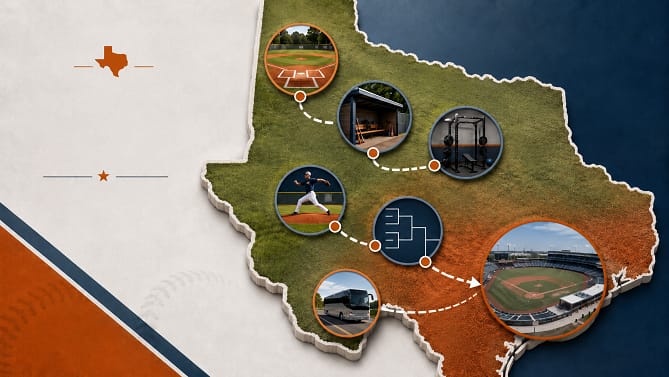
For texaselitebaseball.org readers, that depth is the story. Texas baseball development is not limited to one city, one showcase circuit, one player type, or one recruiting label. The state tournament rewards teams that can pitch, defend, adjust, travel, handle pressure, and compete across a long season.
That is the clearer message for players and families. The next level does not begin with a scholarship offer. It begins with daily habits that can survive a bigger game. The 2026 UIL tournament gave Texas a clean reminder of what those habits look like when the lights come on at Dell Diamond.