The Texas Collegiate League is not a high school showcase, and that is exactly why it matters to high school baseball families across Texas. For players trying to understand what comes after varsity baseball, summer tournaments, and recruiting camps, the TCL offers a live example of the next level: older athletes, college rosters, wood-bat pressure, travel routines, daily competition, and public performance data. The league’s 2026 season lists eight teams, including Texas-based clubs in Bryan, San Antonio, Victoria, Abilene, and Sherman, giving players across the state a practical window into what college baseball asks from athletes once the recruiting conversation turns into roster reality. The TCL’s official team page gives families a clear map of that regional footprint through the Texas Collegiate League teams.
For texaselitebaseball.org readers, the value is not in treating the TCL as a destination every high school player will reach. The better angle is developmental. The league shows what separates promising high school talent from college-ready baseball habits: strike-zone control, defensive reliability, physical maturity, travel recovery, mound management, and the ability to perform when every at-bat is being tracked.
Why The TCL Makes College Baseball Feel More Concrete
High school players often hear broad phrases about “playing at the next level,” but the TCL turns that idea into something easier to study. Its 2026 team list includes the Brazos Valley Bombers in Bryan, the San Antonio River Monsters in San Antonio, the Victoria Generals in Victoria, the Abilene Flying Bison in Abilene, and the Sherman ShadowCats in Sherman, with Louisiana-based teams in Youngsville, Baton Rouge, and Lake Charles rounding out the league. That layout matters for Texas families as it places summer collegiate baseball inside real driving distances, real communities, and real ballparks rather than inside abstract recruiting language.
The TCL’s expansion for 2026 gave the league two new Texas markets, Sherman and Abilene, and the official schedule announcement framed that growth around regional competition and summer collegiate baseball across Texas. That is useful context for younger players as it shows how the college game depends on more than school names. It depends on summer assignments, roster construction, coach recommendations, host communities, and the chance to keep playing against serious competition after the spring college season ends. The league’s own announcement of the 2026 TCL schedule puts the expansion into a real calendar and geography.
For high school players, the lesson is simple but useful: college baseball is not only about getting recruited. It is about earning playing time once every roster is filled with players who were once standouts in their own towns. Summer collegiate leagues make that reality visible.
How Summer Collegiate Baseball Shows The Difference Between Tools And Habits
A high school player can look impressive in a single showcase setting. A strong 60-yard dash, a loud round of batting practice, or one high-velocity bullpen can help a player get noticed. The TCL points toward a different question: can a player repeat performance across a summer schedule?
That matters for hitters who must handle breaking balls in game counts, pitchers who need to hold velocity while throwing strikes, and defenders who cannot let one mistake carry into the next inning. College coaches are not only evaluating raw ability. They are looking for players who can make adjustments, handle scouting reports, work inside a team plan, and compete with older athletes.
This is where a same-domain development lens fits naturally. A player who already uses a structured baseball development plan can watch the TCL with better questions. Instead of asking whether a player “looks good,” a high school athlete can study how college players control routines: pregame work, two-strike approach, bullpen tempo, base-running choices, dugout communication, and between-game recovery.
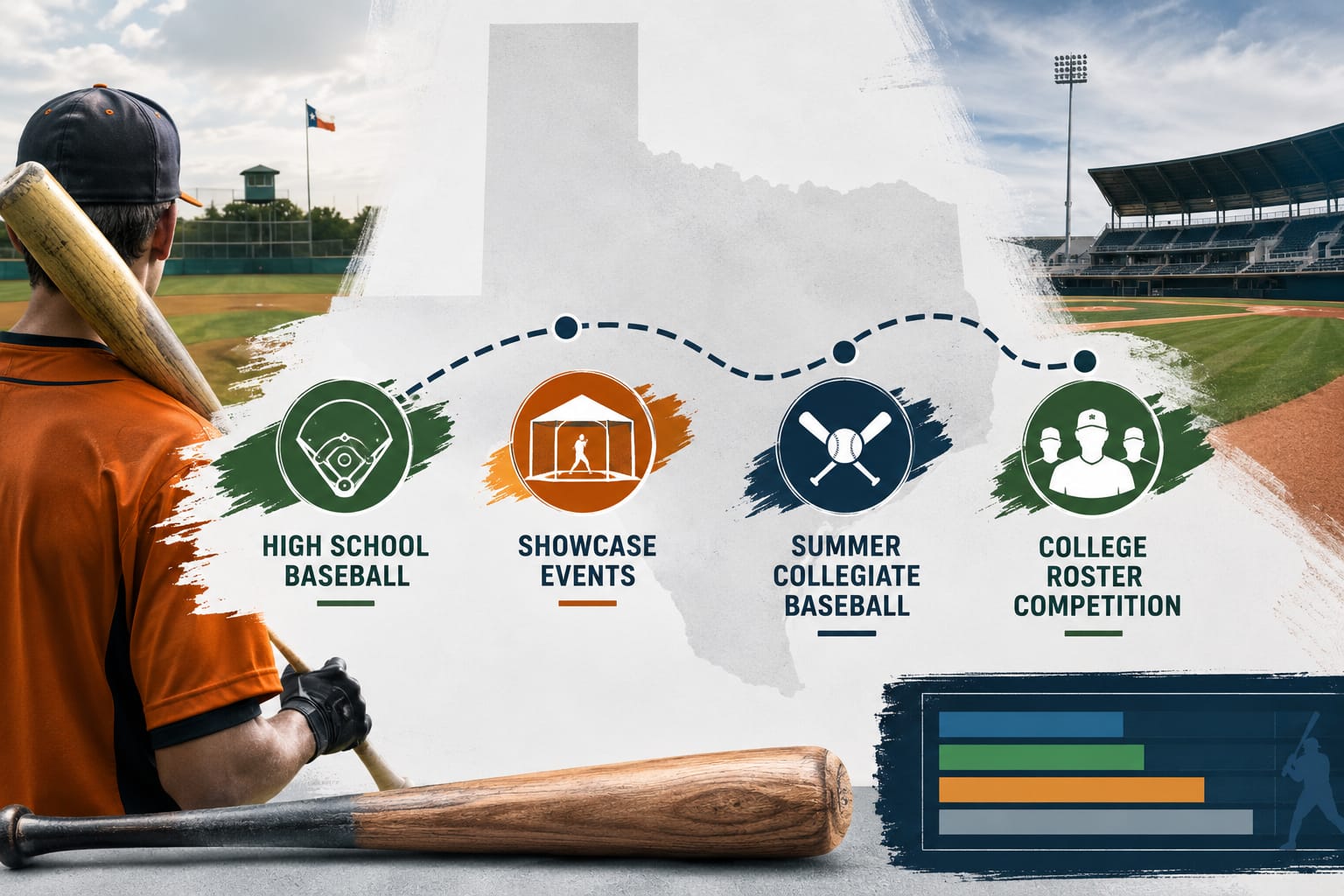
That shift is valuable for families as well. It keeps the recruiting process from becoming a collection of isolated events. Showcases, tournaments, lessons, strength work, and school seasons should connect to a bigger player-development plan. The TCL helps show what those pieces are supposed to prepare a player for.
Why Public Stats And Weekly Recognition Help Players Understand Standards
The TCL’s official site is built around teams, schedules, stats, news, and weekly player recognition. Its June 29, 2026 updates named Victoria’s Jace Martinez as Week Four Player of the Week and Lake Charles’ Cole Flanagan as Week Four Pitcher of the Week, while the league news page listed game recaps through June 30. Those updates matter less as headlines and more as examples of how performance becomes visible in the college baseball ecosystem.
High school players should pay attention to that visibility. Once baseball reaches the college level, production is not just remembered by teammates or local fans. It is logged, compared, clipped, discussed, and evaluated over time. A player’s summer is often read through consistency, not one loud weekend.
That does not mean every player should chase public recognition. It means the development target becomes clearer. A hitter needs at-bats that show plate discipline as well as contact quality. A pitcher needs outings that show command as well as velocity. A catcher needs receiving, leadership, blocking, and throwing habits that hold up when pitchers are still learning how to attack advanced hitters.
| TCL Signal High School Players Can Study | What It Teaches About The Next Step |
|---|---|
| Daily game recaps | College players must reset quickly and compete across a schedule |
| Player and pitcher of the week awards | Repeatable production is easier to trust than one showcase moment |
| Public statistics | Performance becomes trackable and comparable |
| Regional teams across Texas | Summer baseball creates real travel, roster, and community demands |
| Older college competition | Physical maturity and baseball IQ become harder to separate from talent |
The more useful scouting lesson is not “copy the best player.” It is to ask what habits show up repeatedly when the competition gets older.
How The NCAA Calendar Makes Summer Baseball Part Of A Bigger Recruiting Picture
The NCAA’s official recruiting calendar page includes the 2025-26 Division I Baseball Recruiting Calendar and Division II recruiting guides, which matters for families trying to understand when coaches can evaluate, communicate, and manage recruiting activity. That calendar does not turn the TCL into a high school recruiting event, but it does show why summer baseball sits inside a broader college timeline. Players are trying to develop, colleges are trying to build rosters, and families are trying to make smart choices about exposure, academics, travel, and fit. The NCAA’s baseball recruiting calendar is the better reference point than rumor-driven recruiting advice.
For high school players in Texas, that calendar should create discipline. Not every weekend needs to become a showcase. Not every camp invite deserves the same cost or travel time. Not every “exposure” opportunity leads to a real evaluation. Watching how TCL players build value can help families sort the difference between activity and progress.
The college game rewards players who understand role, timing, and development fit. A player might be a starting shortstop in high school but project better as a college second baseman or outfielder. A pitcher might get recruited for velocity but earn innings through command and durability. A catcher might not post the loudest showcase metric yet still stand out through how he manages a staff.
The TCL makes those lessons easier to see because it sits closer to the college game than a typical high school tournament. It gives families a chance to watch players who already crossed the recruiting bridge and are now working to prove they belong in the next environment.
Why The MLB Draft League Comparison Raises The Standard For Evaluation
The MLB Draft League offers a useful comparison because it shows how advanced summer baseball can become when draft visibility, scouting technology, and older competition are part of the structure. Its official FAQ says the first half of the 2026 season features draft-eligible players from Division I, Division II, Division III, NAIA, junior college, and graduating high school senior levels, with data and video made available to athletes, college coaches, MLB clubs, and scouts. That does not make the TCL the same product, but it helps Texas players understand where the development ladder can lead. The MLB Draft League’s summer baseball format shows how performance, technology, and scouting visibility become more connected as the level rises.
That comparison is useful for elite Texas high school players who are surrounded by rankings, social clips, and showcase numbers. The higher the level, the less a single metric can carry a player by itself. Velocity still matters. Exit speed still matters. Speed and arm strength still matter. Yet the game keeps asking whether those tools help a team win innings.
This is where TCL baseball can sharpen a player’s perspective. A high school pitcher can watch how older arms sequence hitters. A young infielder can study footwork before the throw, not just the throw itself. A catcher can study how body language affects a pitcher after a missed spot. An outfielder can watch routes, first steps, and communication in parks where the ball does not always carry the same way.
Those are college baseball skills, and they are easier to understand when players see them in a real summer league setting.
What Texas High School Players Should Watch During A TCL Game
The best way for a high school player to use the TCL is not as a fan chasing names. It is as a student of the game. A player can watch one inning and learn more by focusing on three details than by trying to judge every athlete on the field.
A hitter should study how TCL players manage counts. Do they give away at-bats after falling behind? Do they adjust after seeing a breaking ball? Do they move runners without trying to do too much? Those small choices tell a high school player what competitive at-bats look like when pitchers throw more strikes and defenses punish mistakes.
A pitcher should watch tempo, first-pitch strike rate, and body language after traffic reaches base. College baseball does not remove pressure; it exposes how players respond to it. A defender should study pre-pitch movement, exchange speed, throwing lanes, and how players communicate when the ball is not hit to them.
For parents, the viewing lens should be practical. The TCL can show why physical strength, nutrition habits, academic readiness, travel maturity, and coachability are part of the baseball pathway. A player who wants college baseball needs more than a good swing or one strong pitch. He needs a routine that can survive a heavier baseball life.
Why This Matters For The Next Texas Baseball Step
The Texas Collegiate League gives high school players a clearer picture of the next baseball step because it removes some of the mystery. College baseball is still competitive, selective, and difficult. Yet the TCL turns that difficulty into something players can watch, study, and use.
For Texas families, the league’s 2026 footprint across Bryan, San Antonio, Victoria, Abilene, and Sherman creates a useful regional window into summer collegiate baseball. For coaches, it offers teaching material. For players, it shows why development has to move beyond showcase moments and toward repeatable baseball habits.
The real lesson is not that every high school player should aim for one summer league. The lesson is that the college game has a different rhythm. It asks players to perform, recover, travel, adjust, and compete against athletes who were already good enough to earn roster spots. The sooner a player understands that standard, the smarter his training plan becomes.
For texaselitebaseball.org readers, that is the value of the TCL. It is a Texas-centered example of what comes after high school baseball starts getting serious: not hype, not guesses, but a visible level where tools have to become habits.