The Baseball Youth All-American Games in Conroe give Texas families a clear summer target: four scheduled event days, a known venue, age-based divisions, and a format that includes tournament games plus optional skill events. The 2026 Conroe stop is scheduled for July 23-26 at Scrap Yard Sports, 29607 Robinson Rd., Conroe, TX 77385, according to Baseball Youth event information.
For players, the value is not just the uniform package or a busy week at the park. The better question is how a family uses the event to evaluate habits, compete against unfamiliar peers, and bring useful notes back into fall training. Texas athletes can gain a lot from a national-style event if the week is framed around preparation, game awareness, and honest post-event review.
Baseball Youth All-American Games Schedule And Venue
Baseball Youth All-American Games Dates
The event window is July 23-26, 2026. For Texas families, the Baseball Youth All-American Games sit in a part of the baseball calendar where summer reps can either sharpen a player or wear him down. That means the week before the event matters. Throwing volume, cage work, defensive reps, and rest should be planned with the scheduled games in mind rather than squeezed around last-minute travel.
Baseball Youth lists the Conroe event at Scrap Yard Sports. Families should use the published address, 29607 Robinson Rd., Conroe, TX 77385, for lodging searches, arrival planning, and daily route checks. The research provided confirms the event dates and site, but it does not confirm final check-in times, field assignments, or team schedules. Those details should be verified directly through the event organizer before families lock in daily plans.
Scrap Yard Sports Logistics
Scrap Yard Sports is the listed host venue for the Conroe event. The research describes it as a sports complex that hosts youth sports events. That matters because families should expect a tournament-style environment where players move between warmup space, dugouts, game fields, and skill-event areas. Parents can help by keeping the athlete’s routine simple: arrive early enough to warm up, keep gear organized, and limit distractions between games.
Conroe is also a practical location for many Texas families because it keeps the event within state lines while still drawing players from outside a local league setting. That mix can be useful for development. A player who normally dominates familiar competition may be forced to adjust to different pitchers, defensive pace, and dugout personalities. Coaches and parents should watch how the athlete responds when the game does not follow his normal rhythm.
Roster Age Groups And Game Expectations
Age Divisions From 9U To High School
The event lists divisions from 9U through high school, including 9U, 10U, 11U, 12U, 13U, 14U, and high school levels. That range creates different development questions. A 9U or 10U player may need help managing nerves, basic readiness, and defensive attention. A 13U, 14U, or high school player should be judged more on repeatable routines, communication, swing decisions, and mound presence.
Families should avoid comparing a younger player’s week to an older athlete’s week. The event format spans a wide age range, but development does not move at the same speed for every player. For younger divisions, a productive event may mean learning to prepare without a parent managing every step. For older players, the week can test whether tools show up during game conditions rather than only during workouts.
What Three Guaranteed Games Mean
Each participant is guaranteed at least three games during the tournament, according to the Baseball Youth event listing. Three games are enough to reveal patterns, but not enough to define a player. One hard-hit ball caught by an outfielder or one rough inning should not drive a family’s evaluation. The better review is built from repeated behaviors: first-pitch readiness, body language after failure, baserunning decisions, defensive spacing, and ability to make an in-game adjustment.
For pitchers, families should track how the athlete prepares before taking the ball and how he responds if command is not present early. For position players, the same logic applies at the plate and in the field. A good weekend is not limited to box-score production. It can include better pitch recognition, cleaner routes, sharper communication, or stronger focus late in a long day.
How Baseball Youth All-American Games Skills Fit Development
Optional Measurement Events
The event offers optional skills competitions: Home Run Derby, Throwing Velocity, Exit Velocity, Pitchers Velocity, 60-Yard Dash, and Catchers Pop Time. Baseball Youth also lists a participant package that includes two Stinger jerseys, a limited-edition hat, and a commemorative championship-style ring through its event details.
Those skill events can be fun, but Texas families should treat them as snapshots rather than final labels. A single exit velocity reading or sprint time is useful only when it is placed beside training history, game performance, and physical maturity. Players may post a number they like, or they may miss their personal target. Either result can help if the family turns it into a training conversation instead of a social-media verdict.
Turning Event Data Into Training
A Home Run Derby can show how a hitter handles controlled pressure. Throwing Velocity and Pitchers Velocity can point toward arm strength, but they should not replace command, recovery discipline, or safe workload habits. Exit Velocity can reflect contact quality in a controlled setting, while the 60-Yard Dash and Catchers Pop Time can give a rough look at speed and position-specific quickness. None of those measures should stand alone.
After the event, athletes should meet with their regular coach and review what showed up. Did the player rush under pressure? Did the swing hold its shape against better pace? Did the catcher’s transfer stay clean? Did a pitcher compete without his best stuff? That review is where the event can support real growth. Families wanting more context on using event reps well can compare notes with individual development in youth baseball events.
Travel Planning For Texas Families
Stay-To-Play Requirements
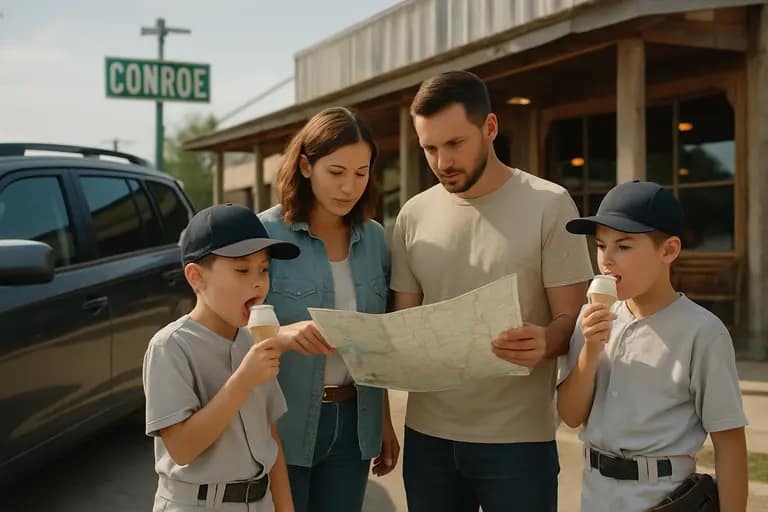
The Conroe event operates under a stay-to-play policy, which means participants are required to book accommodations through designated channels. Families should account for that before choosing a hotel based only on distance, points, or price. The research confirms the policy, but not the full hotel list or booking process. Those details should come directly from the event registration path or organizer communication.
Travel planning affects performance more than many families admit. A player who arrives rushed, underfed, or unsure of where to be can carry that stress into warmups. Since the event runs across multiple days, families should build a repeatable daily plan. The plan does not need to be complicated: uniform ready the night before, snacks packed, water available, arrival time set, and postgame recovery kept calm. For a broader family-centered view of this same event type, the site’s All-American Games family planning article pairs well with the Conroe schedule.
Nominations And Player Fit
Nominations are open, and the research states that athletes from all skill levels and regions are welcome. That detail is worth reading carefully. Families should not treat nomination access as a ranking, recruiting promise, or proof that a player is ahead of peers. It is an entry point into an event setting. The right fit depends on whether the athlete is ready to compete, listen, adjust, and handle a multi-day baseball environment.
For some players, this type of week can build confidence. For others, it can expose a gap in preparation. Both outcomes are useful if the adults around the player respond the right way. A tough game should not become a panic point. A strong game should not become a reason to skip skill work. The purpose is to collect better information about where the player stands and what should be trained next.
What Conroe Players Should Track During The Event
Game Notes That Matter
The Baseball Youth All-American Games should be treated as a development checkpoint. Players can keep a short notebook or phone note after each day, as long as it stays simple. Useful notes include the best at-bat, the toughest pitch, one defensive read, one baserunning decision, and one mental response after failure. Pitchers can record what pitch they trusted most, what command issue appeared, and how they handled runners on base.
Parents can help by asking questions instead of giving a full postgame lecture. What did you see well today? What sped you up? What would you train this week if the event ended tonight? Those questions push the player toward ownership. Coaches can then turn those answers into cage work, bullpen focus, defensive reps, or strength and speed priorities.
Why The Week Should Lead Back To Training
The Conroe event gives players games, optional measurements, and a setting with peers from outside their normal baseball circle. That is enough to make the week meaningful, but only if the follow-up is honest. A player’s next step may be improved throwing accuracy, better swing decisions, cleaner catcher exchange work, stronger sprint mechanics, or a calmer pregame routine.
The families that benefit most will arrive prepared, verify organizer details, respect the stay-to-play process, and judge the event through a development lens. The schedule, venue, age divisions, game guarantee, and skills options are already enough to plan around. The real value comes from how each athlete competes, learns, and carries the lessons back into his regular Texas baseball environment.