In today’s youth sports, making it to the next level is a tough battle. Only 7% of high school athletes get to play at the next level. It’s as hard as getting Taylor Swift tickets during a presale.
At Inspiration Academy, they’ve made this challenge an art. They’ve helped 150+ athletes get into college. They teach athletes to be their own agents. Even LeBron had to sell himself once.
It’s not just about sports. Director Jerry Beard says athletes should be celebrated, not just tolerated. They use Trackman data and social media to change the game.
This isn’t just about getting offers. It’s about finding the right fit. Most kids don’t make it to the next level.
Club/School Support
Do you think your kid’s travel team is ready for college baseball? It’s like comparing beer league softball to the World Series. The gap between amateur support and professional club infrastructure is huge.
Real club support means having a team like Inspiration Academy. They have a whole coaching staff with connections that would impress even the best lobbyists. These coaches aren’t just teaching the basics; they’ve played at high levels.
- Social media experts to make your kid famous (in a good way)
- Contacts with MLB, NCAA, JUCO, and NAIA who actually answer their phones
- Trackman Portable Units to collect lots of data
This isn’t just about better coaching. It’s about turning “maybe we’ll look at him” into “when can he start?” This leads to better sports scholarships and opportunities.
Let’s compare elite programs to typical travel teams:
| Support Feature | Typical Travel Team | Elite Academy Program |
|---|---|---|
| College Connections | Maybe a few local coaches | National network across all divisions |
| Data Analytics | Basic stats tracking | Professional-grade performance metrics |
| Recruitment Strategy | Hope they get noticed | Proactive social media & outreach |
| Facility Access | Public fields when available | Professional-grade training facilities |
Places like IMG Academy don’t just handle paperwork. They build the foundation for turning talent into scholarship offers. They know that college placement is more than just developing talent; it’s about strategic positioning.
Your kid might have incredible skills. But without the right support, those skills might go unnoticed. The right program doesn’t just develop players; it markets them to those who offer sports scholarships.
Key Metrics for Success
Welcome to a new era in talent evaluation, where radar guns are just the start. The real game-changers in today’s college athletics are metrics that would amaze Billy Beane. They’re like a symphony of data.
While everyone focuses on fastball velocity, the real game-changers are metrics that measure baseball’s dark matter. Inspiration Academy’s Trackman system tracks spin rates that would make a vinyl DJ jealous. It also measures ball movement and spin efficiency with incredible precision.

But here’s where it gets really interesting. IMG Academy published a white paper that’s like a sci-fi novel about the athlete of 2030. They say we’re measuring the wrong things. The metrics that will determine success are not what you’d expect.
Instead of just tracking how far someone can hit a baseball, they’re measuring resilience. They’re looking at how many times a player can get knocked down and get back up. They’re also measuring social influence – can this athlete lead when everything’s on the line?
RPS Academies takes this even further. They blend high-performance metrics with sports science evaluation that would impress NASA engineers. They’re creating athlete profiles that look like psychological thrillers.
| Traditional Metrics | Next-Gen Metrics | Why It Matters |
|---|---|---|
| Fastball Velocity | Spin Efficiency | Movement quality over raw speed |
| Batting Average | Exit Velocity Consistency | Sustainable power versus luck |
| 40-Yard Dash Time | Reactive Agility | Game-speed movement matters most |
| Vertical Jump | Mental Flexibility | Adapting to failure determines longevity |
| Bench Press Max | Social Leadership Score | Teammates follow winners, not lifters |
The table tells the real story. We’ve moved from measuring what athletes can do to understanding who they are under pressure. That spin rate might get you noticed, but your resilience score gets you recruited.
Colleges aren’t just building teams anymore – they’re building cultures. They want players who can handle a 3-2 count with bases loaded in the ninth, yes. But they also want athletes who can handle a tough sociology exam after losing a weekend series.
The new metrics create a fascinating paradox. The most advanced technology we’ve ever developed is measuring the most human qualities: grit, adaptability, and the ability to inspire others. It’s Moneyball meets mindfulness, and it’s changing everything about how we evaluate talent in college athletics.
So the next time you’re watching a recruit, don’t just watch the radar gun. Watch how they respond to a bad call. Watch how teammates react to their presence. Those are the metrics that truly matter in the modern game.
Success Stories
Let’s talk about what really matters: tangible results. Many programs promise the world, but only a few deliver success stories year after year.
Take Inspiration Academy’s college board. It’s not just a list; it’s a Who’s Who of American higher education. Their wall of fame is filled with top college placements that make any student-athlete excited.
RPS Academies is like a Swiss watch, consistent and successful. For 14 years, they’ve had a 100% university scholarship placement rate. This is amazing in the world of athletic recruitment.
Their alumni list is impressive:
- Nicole Melichar – tennis prodigy turned professional
- Maria Camila Osorio – rising star in collegiate tennis
- Fred Biondi – making waves in university competitions
These stories aren’t just one-offs. They’re part of a proven system that turns talent into fully-funded educations at top schools.
| University | Sport | Notable Alumni | Scholarship Type |
|---|---|---|---|
| Harvard University | Tennis | Multiple NCAA competitors | Full athletic scholarship |
| University of Pennsylvania | Multiple sports | Ivy League champions | Academic-athletic combination |
| William & Mary | Tennis, Golf | Conference leaders | Full athletic scholarship |
| University of Miami | Tennis | Professional prospects | Full athletic scholarship |
| Duquesne University | Basketball, Tennis | Division I starters | Athletic scholarship |
What sets these programs apart? They know sports scholarships are about more than just sports. They’re about creating well-rounded student-athletes.
The magic happens when talent meets the right opportunity. These stories show that with the right program, sports scholarships can launch careers.
These athletes aren’t just winning games. They’re getting access to education that would be hard to get without scholarships. This shows that success can happen off the field too.
Navigating the Recruitment Process
Welcome to college athletics’ version of Survivor. The transfer portal can change everything. While you’re perfecting your skills, coaches are looking for bargains in college.
IMG Academy’s research shows a harsh reality. With extended eligibility and roster caps, spots are taken by fifth-year seniors. It’s like musical chairs, but the music stopped long ago.
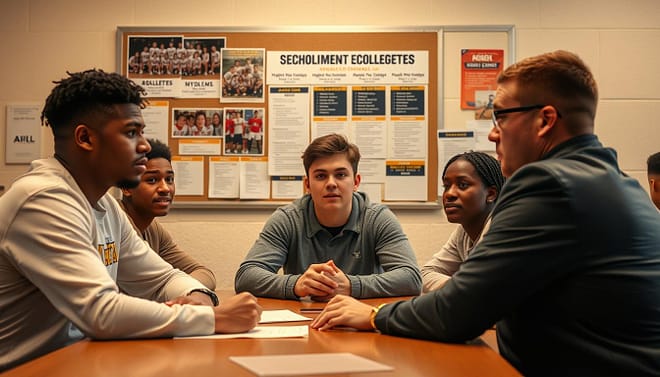
Successful programs like Inspiration Academy know the secret. They start talking to athletes by junior year, not when it’s too late. Coach Beard and his team focus on academics, location, and program fit.
Here’s a secret they don’t share in brochures: grades and character matter more than baseball skills. Colleges look at graduation rates and whether you’ll stay out of trouble.
The modern recruitment strategy is like chess. It requires careful planning. Here are some key moves:
- Start serious talks by junior year
- Check if your grades match the program
- Look beyond win-loss records to understand the culture
- Know how transfers affect scholarships
- Have a backup plan for when spots disappear
Finding the right program is more than getting recruited. It’s about finding a place that values you long-term. It’s about being seen as more than just a temporary player.
The college athletics world is like a business world. Athletes need to think like CEOs. Is the academic support right for you? Will the location work for four years? Is the coaching style a good fit?
In today’s game, nothing is more unpredictable than your scholarship offer. Smart recruits look for a home, not just a team. They want a place that will stay with them, even when the transfer portal opens.
Parent Involvement
Your role in the sports scholarship journey is more than just driving or cheering. IMG’s research shows you’re part of a huge group heading to college. Over 50% of high school students play sports, making it a major path to education.
Sports are not just extra activities. They are education with a twist. It’s not just about keeping kids busy. It’s about investing in their future, just like academic classes.
The financial and time commitment is big. But the rewards can be huge. Sports scholarships and other opportunities can change lives.
Here’s how to be involved without being too much:
- Be the strategist, not the coach: Understand the recruitment world, not just yell advice
- Track the metrics that matter: GPA, tournament schedules, and coach communication
- Network like a pro: Connect with other sports parents who’ve succeeded
- Document everything: Keep game footage, academic records, and coach communications ready
The best sports parents are like college counselors and sports agents. They know today’s tournaments are about visibility. Talking to coaches is about building relationships.
Your investment is more than just fees and travel. It’s about character, time management, and sports scholarships. Successful parents see every practice and tournament as part of their child’s education.
But remember, being involved doesn’t mean being too much. The best parents:
- Know when to advocate and when to step back
- Let their child own the process
- Focus on long-term growth over short-term wins
- Build relationships, not burn bridges
This journey needs more than just showing up. It requires strategy, financial planning, and emotional smarts. The reward? Watching your child get sports scholarships and develop valuable life skills.
You’re not just a sports parent. You’re an educational strategist. Take this role seriously, and you might help secure a life-changing opportunity.
Red Flags to Watch
College athletics can feel like the wild west. You need to spot the dangers before you step in. One big warning sign is when programs treat athletes like products, not people. If they ignore your education or if you don’t fit, it’s time to leave.
Another red flag is the transfer portal paradox. Some teams prefer keeping current players over new talent. This can push out newcomers. IMG Academy says this hurts team stability.
Extended eligibility also poses a problem. Fifth and sixth year players might take spots from new recruits. This limits chances for fresh talent. It’s a big issue in college sports today.
Inspiration Academy advises: choose a place where you’re celebrated, not just tolerated. The right fit is more important than fame. It’s not just about playing sports. It’s about finding a place where you truly belong.