Ensuring Safety and Standards in Youth Sports Camps
At our youth sports camps, we prioritize the safety and well-being of every participant. We understand the importance of creating a secure environment where children can learn and grow. That’s why we have implemented strict safety protocols and adhere to the highest standards in the industry.
Our camps are staffed by experienced and certified coaches who undergo rigorous background checks and training. We ensure that our coaches are equipped with the necessary skills and knowledge to provide a safe and supportive environment for all participants.
We also have a team of dedicated medical professionals on site to handle any medical emergencies that may arise. Our camps are equipped with first aid kits and have access to nearby medical facilities if needed.
In addition to our safety measures, we follow strict operational excellence standards to ensure the smooth and efficient running of our camps. This includes maintaining clean and well-maintained facilities, adhering to proper hygiene practices, and providing clear instructions and guidelines to participants and staff.
We believe that by prioritizing safety and adhering to industry standards, we can create a positive and enriching experience for every child who participates in our youth sports camps. We are committed to providing a secure environment where children can learn, grow, and develop their skills in a safe and supportive setting.
Our Commitment to Safety and Standards
At our youth sports camps, we are dedicated to ensuring the safety and well-being of every participant. We understand the importance of creating a secure environment where children can learn and grow. That’s why we have implemented strict safety protocols and adhere to the highest standards in the industry.
Our camps are staffed by experienced and certified coaches who undergo rigorous background checks and training. We ensure that our coaches are equipped with the necessary skills and knowledge to provide a safe and supportive environment for all participants.
We also have a team of dedicated medical professionals on site to handle any medical emergencies that may arise. Our camps are equipped with first aid kits and have access to nearby medical facilities if needed.
In addition to our safety measures, we follow strict operational excellence standards to ensure the smooth and efficient running of our camps. This includes maintaining clean and well-maintained facilities, adhering to proper hygiene practices, and providing clear instructions and guidelines to participants and staff.
We believe that by prioritizing safety and adhering to industry standards, we can create a positive and enriching experience for every child who participates in our youth sports camps. We are committed to providing a secure environment where children can learn, grow, and develop their skills in a safe and supportive setting.
Coach Vetting: Background Checks & Certifications
You wouldn’t hire a pilot without checking their flight hours. So, why trust a coach without checking their credentials? It’s about doing the right thing, not doubting someone’s worth. The first step in keeping kids safe is checking the coach’s background.
Glen Johnson, the CFL’s VP of Officiating, says their checks are thorough. We do the same for our staff screening. A basic background check is just the start. We dig deeper to really know who we’re dealing with.
What does that deeper dive look like? It’s like a forensic accountant’s dream. We verify everything, from CPR cards to coaching licenses. We don’t just take things at face value.
But we don’t stop there. A clean record is important, but so is a coach’s history. We look for a “culture of excellence” in their past. Did they make a positive impact? Do people respect them?
This detailed approach to background checks helps protect kids in sports. It’s like analyzing someone’s character. We check:
- Multi-state criminal background checks (because people move)
- Sex offender registry cross-references
- Professional reference validation with specific, behavior-focused questions
- Social media footprint analysis for alignment with program values
- Verification of all claimed education and employment history
This isn’t just staff screening. It’s about finding the right people. The integrity of your program depends on them. Building trust and safety takes verified credentials and references.
The difference between a good program and a bad one is in the details. Anyone can run a database search. But building trust and safety means understanding the story behind the data.
In the end, thorough background checks and certification validation are essential. They turn vague promises into real standards. Parents can relax knowing the coaches have been carefully checked.
Player-to-Coach Ratios by Age Group
The math of supervision ratios is key to a child’s camp experience. If it’s off, the camp could turn chaotic. Imagine one referee trying to manage a whole CFL game.
Think about a CFL game. It has specific numbers for a reason. This is to keep the game flowing and safe. Now, replace professional athletes with eight-year-olds and soccer balls with soccer balls. The need for safety becomes clear.
Younger kids need tighter ratios. It’s not just about teaching skills. It’s also about emotional support. A coach must watch for signs of trouble, like a child getting too hot or upset.
As kids get older, ratios can loosen up a bit. But the focus on safety never wavers. A coach with too many kids to watch misses important details. They might miss a child getting hurt or feeling left out.
The Ratio Breakdown: Why One Size Doesn’t Fit All
Different ages need different things. Here’s how camp safety & standards work out in numbers:
| Age Group | Recommended Ratio | Primary Focus |
|---|---|---|
| 5-7 years | 1 coach : 6 players | Constant supervision, basic skill building, emotional support |
| 8-10 years | 1 coach : 8 players | Skill development, conflict mediation, group dynamics |
| 11-13 years | 1 coach : 10 players | Tactical instruction, peer leadership, safety awareness |
| 14+ years | 1 coach : 12 players | Advanced strategy, autonomy, mentorship |
These numbers aren’t random. They’re based on how kids develop and what they need. Young kids need more help and attention. Their skills and understanding of risks are just starting.
The youngest kids need the most help. Every coach should be close to every child. It’s about helping with small problems, like hurt feelings or not being “it.”
Beyond the Numbers: The Quality of Supervision
A tight ratio means nothing if coaches aren’t trained. It’s not just about being there. It’s about being attentive.
Good ratios help coaches:
- Give feedback on technique
- Watch each child’s health during activities
- Stop social problems fast
- Keep an eye on everyone all the time
When these conditions are met, youth sports safety becomes real. Coaches can prevent problems before they start. They’re not just fixing things as they go.
Remember, the right supervision ratios make learning safe and fun. They’re like a defensive line in the game of child safety. And in that game, safety is the only score that matters.
Heat & Weather Policy: From Slogan to Science
While the Roughriders brave -15°C in Western Finals, your summer camp faces the opposite extreme. It’s a battle against heat that demands more than good intentions. Professional athletes in Saskatchewan play through frozen turf with rules. Your youth sports safety program needs policies for when the sun is the opponent.
This isn’t about being the fun police. It’s about making “safety first” a science. The difference between a safe camp and an incident report often depends on Wet Bulb Globe Temperature.
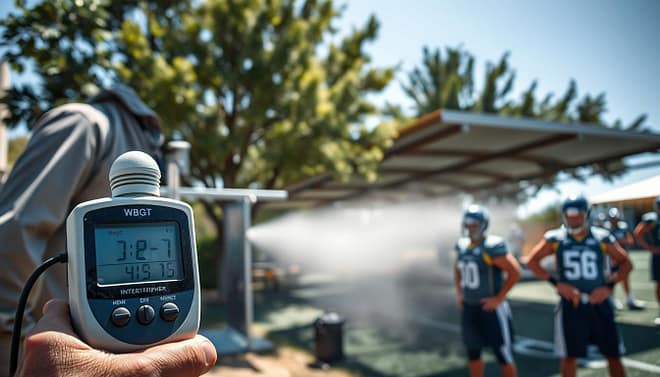
Your phone’s temperature app lies. Or at least, it tells a story that’s not complete. WBGT—the real measure of heat stress—considers humidity, wind, sun angle, and radiation. It’s why 88°F in dry Arizona feels okay, but 88°F in humid Florida can be deadly. Proper WBGT monitoring is essential, not just equipment.
So, what does a real weather safety protocols system look like? It’s not just “drink water if it’s hot.” It’s like NASA mission control.
- Mandated Shade Breaks: Not suggestions. Scheduled rotations where activity stops completely, no exceptions.
- Active Misting Stations: Strategic cooling zones, not decorative sprinklers. Evaporation is physics, and we should use it.
- Hydration Pauses: Timed water breaks before thirst signals—because by then, dehydration has already started.
- WBGT Threshold Triggers: Clear action levels (modify, suspend, cancel) based on actual data, not a coach’s gut feeling.
The Roughrider faithful don’t show up to November games in shorts. They prepare for the environment. Your camp safety & standards must show the same planning. When WBGT hits specific thresholds, your response should be automatic.
Consider this: heat illness prevention is almost entirely avoidable with proper protocols. Exertional heat stroke has a 100% survival rate when recognized immediately and treated with rapid cooling. The tragedy isn’t in the medical complexity—it’s in the policy failure.
Your policy should answer questions before parents ask them. At what exact WBGT reading do we move activities to full shade? When do we implement mandatory five-minute cooling breaks every twenty minutes? What’s our absolute cancellation threshold? This specificity transforms anxiety into confidence.
The alternative? A reactive scramble when a kid shows early symptoms. That’s not youth sports safety—that’s crisis management. Professional teams have weather spotters and emergency action plans. Your camp deserves the same level of respect for its participants.
Implementing true heat illness prevention means embracing uncomfortable truths. Sometimes, the safest—and most professional—decision is to not play at all. The Roughriders would never risk their players on unsafe frozen turf. Why would we risk children on unsafe heat?
This is where camp safety & standards separate the serious from the superficial. It’s not about fear. It’s about applying the same rigorous, analytical planning to summer heat that professionals apply to winter frost. The thermometer doesn’t care about your schedule. But your policy should care deeply about every degree on that WBGT monitor.
Concussion Awareness & Return-to-Play Steps
In 2014, the CFL made big changes to protect players’ heads. They banned hitting an opponent’s head or neck. They also made a rule that any player showing injury signs must leave the field for at least three plays.
This matters for your kid’s sports camp. Clear rules help keep everyone safe. When rules are unclear, coaches might push players too hard. This is not okay in today’s camp safety & standards.
Spotting a concussion is not easy. It’s not just about a big hit. Look for signs like confusion, clumsiness, headaches, sensitivity to light, or acting foggy.
- Confusion about the play or position
- Clumsiness or balance issues
- Headache that won’t quit
- Sensitivity to light or noise
- Just seeming “off” or foggy
Every coach needs to know these signs. It’s not just a skill—it’s a must. A young brain is very sensitive. A hit that might not bother an adult can harm a child’s development.
What happens after a suspected concussion? The player is taken out right away. No waiting to see how they feel. A doctor must clear them before they can start playing again.
The return to play is gradual. You can’t just go from feeling bad to playing full speed. Here’s what happens:
- Complete Rest: No physical or mental strain. This means no practice, no video games, maybe even limited schoolwork.
- Light Aerobic Activity: Walking or stationary cycling. The goal is to increase heart rate without head movement or risk.
- Sport-Specific Exercise: Running drills without contact. Testing coordination and cognitive function under mild exertion.
- Non-Contact Practice: Full participation in practice but with strict no-contact rules.
- Full Contact Practice: After medical clearance, returning to normal practice conditions.
- Game Play: The final step—return to competition.
Each step takes at least 24 hours. If symptoms return, you go back to the previous step. This careful approach respects the brain’s healing time. Rushing can cause serious damage.
Following this head injury protocol takes courage. You’ll face pressure from parents and athletes. But remember, the CFL’s rule is clear: three plays minimum, no exceptions. Your league’s policy should be just as strict. Document every incident. Train every volunteer. Make the protocol as familiar as the game itself.
This is how we change the culture. We stop celebrating “getting your bell rung.” We start prioritizing long-term health over short-term wins. That’s what true youth sports safety looks like—protecting the future of the participant, not just winning today’s drill.
First Aid, Allergies, and Medication Handling
When a child’s airway starts closing during soccer practice, you don’t have time for debate. Your camp safety & standards turn into real action. The difference between a managed incident and a tragedy is seconds and centimeters.
Think of it like professional sports. When an athlete goes down, the trainers act fast. Your camp’s first aid response system should be just as quick. Every coach and staff member should know the drill well.
Let’s talk about the toolkit. Your first aid kits should be more than just boxes with bandaids. They’re key assets. They must be:
- Stocked with current supplies (check those expiration dates monthly)
- Accessible within 30 seconds from any point on the field
- Known by everyone—not just “somewhere in the equipment shed”
The EpiPen protocol needs its own playbook. It’s not a suggestion; it’s a must. Staff training should include hands-on practice with trainers. Everyone should know the signs of anaphylaxis—it’s not just hives, it’s the silent closing of a throat. For more on this, check out our guide to allergic reactions at summer camps.
Medication management is where many programs get nervous. We’re not asking coaches to be pharmacists. We’re asking for a secure, documented system that would make a hospital administrator approve. This means:
- Locked storage that’s accessible only to designated personnel
- Clear documentation for every dose administered (time, medication, staff initial)
- Parent-provided medications in original containers with precise instructions
The “Sage” approach is calm, prepared competence. Panic is the enemy—it spreads faster than peanut dust in a cafeteria. Protocol is the ally. By systematizing your emergency action plan, you’re not just preparing for the worst. You’re creating an environment where parents can breathe easy (sometimes literally).
Consider this: a well-executed first aid response does more than treat the immediate problem. It shows your program’s overall commitment to safety. It tells parents, “We’ve thought about this. We’re ready.” That confidence becomes part of your reputation, woven into your camp safety & standards narrative.
Your EpiPen protocol isn’t just about the injection. It’s about the seconds before—recognizing the crisis. It’s about the minutes after—monitoring, documenting, communicating. This isn’t playing doctor; it’s executing a medical strategy with precision.
Remember, medication management is more than just the crisis moment. It’s the daily administration of inhalers before practice, the insulin shot at the scheduled time, the antihistamine for seasonal allergies. Each requires the same disciplined approach: verify, administer, document. Miss one step, and you’re not managing medication—you’re managing risk.
When you systematize this entire ecosystem, you accomplish something remarkable. You turn possible tragedies into managed incidents. You replace chaos with procedure. And you sleep better at night knowing that if the unthinkable happens tomorrow, your team won’t be debating—they’ll be doing.
Field and Equipment Safety Checks
Imagine the CFL playing on fields with loose sprinkler heads and unstable goalposts. That’s the standard we should apply to youth sports. Professional venues like Mosaic Stadium don’t tolerate such hazards. Your camp shouldn’t either.
This is preventative maintenance 101, yet it’s often the most neglected aspect of camp safety & standards. A daily facility inspection acts as your first line of defense. You’re looking for holes, debris, broken glass, and anything that doesn’t belong.
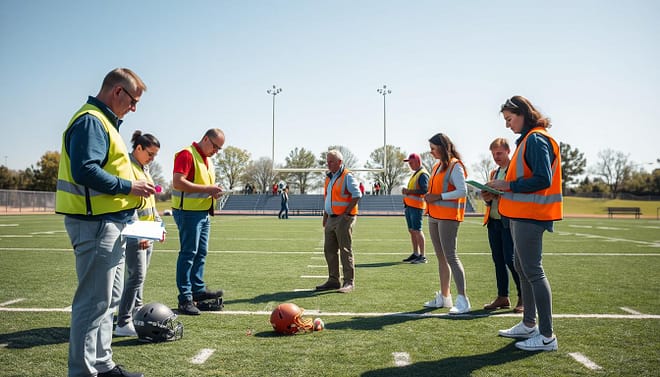
Think of it as a pilot’s pre-flight checklist. Would you board a plane the pilot hadn’t checked? Of course not. The same vigilance applies to the field where children play. A systematic facility inspection neutralizes risks before they become incidents.
Equipment maintenance requires equal scrutiny. Are soccer goals properly anchored? Are helmet straps intact and functional? Are mats secured to prevent slipping? This behind-the-scenes work prevents the freak accident everyone fears.
It’s the sports equivalent of the CFL outlawing “peel back blocks.” You identify the hazard and eliminate it. An effective emergency action plan starts with preventing the emergency. A split seam on a baseball might seem minor. Until it causes a wild pitch toward a young batter’s head.
| Safety Aspect | Professional Venue Standard | Camp Minimum Requirement | Risk if Neglected |
|---|---|---|---|
| Field Surface Integrity | Level, groomed turf with no holes or divots | Daily walk-through to identify and mark tripping hazards | Ankle sprains, falls, impact injuries |
| Equipment Stability | Permanent anchoring of all goals, nets, and structures | Pre-activity verification that all movable equipment is secure | Tip-over accidents, crushing injuries |
| Debris Clearance | Automated cleaning systems and dedicated grounds crew | Visual sweep for glass, rocks, and foreign objects before each session | Cuts, punctures, and contamination |
| Visibility & Lighting | Professional-grade lighting for all conditions | Clear sightlines, no blind spots, adequate natural or artificial light | Collisions, missed hazards, reduced reaction time |
| Emergency Access | Multiple marked access points for medical personnel | Unobstructed pathways for stretchers/EMS to reach any point on field | Delayed emergency response in critical situations |
The table above isn’t just a checklist. It’s a philosophy. Hazard prevention transforms your space from a random field into a controlled environment. This proactive approach defines true camp safety & standards.
Consider the broken sprinkler head. At Mosaic Stadium, it’s fixed immediately. On a public field, it might linger for weeks. Which standard protects your athletes? The answer should be obvious.
Vigilance in equipment maintenance pays dividends. A frayed helmet strap takes two minutes to replace. A head injury lasts a lifetime. Your daily checks are the most important work nobody sees. They build the foundation for your entire emergency action plan.
Ultimately, hazard prevention is about respect. Respect for the space, the equipment, and most importantly, the people using them. It’s the unglamorous work that makes the glamorous moments possible. Safe play doesn’t happen by accident. It happens by design.
Pickup/Drop-Off Procedures & Sign-Out Security
Imagine a Senate roll call for child safety, where every ‘aye’ represents a verified guardian and every absence triggers an alarm. That’s the precision required for secure dismissal at any youth program. The final whistle doesn’t end our responsibility—it shifts it to a different battlefield.
The chaotic transition from camp to car is where most security lapses occur. We’ve all seen it: a scrum of parents, kids darting everywhere, and staff trying to match faces with half-remembered names. It’s a system built on hope, not verification. That’s unacceptable.
Our approach borrows from high-security venues and legal custody protocols. Every child has a pre-approved pickup list. This isn’t a suggestion—it’s a binding document. When someone arrives, they present ID. We check it against our list. No match? No release. It’s that simple.
This is where your investment in background checks pays dividends again. The same staff vetted for coaching are now enforcing gate security. They’re trained to be politely inflexible. “I think that’s his uncle” doesn’t cut it. “She said it was okay” gets a firm no.
The system protects everyone. Children are shielded from non-custodial risks. Parents gain peace of mind. Our organization avoids catastrophic liability. It’s boring administrative work that forms a critical barrier. In a world where we video-review offside calls, we can verify a driver’s license.
Our procedures break down into four clear phases, each with specific protocols:
| Procedure Phase | Security Protocol | Staff Responsibility | Parent Requirement |
|---|---|---|---|
| Morning Drop-Off | Sign-in with staff verification | Check child against attendance, note any special instructions | Physically sign child in, communicate changes |
| Afternoon Pickup | ID verification against authorized list | Match photo ID to pre-approved names, record time | Present valid photo ID every time |
| Unauthorized Attempt | Immediate supervisor alert, child secured | Do not release child, contact director and emergency contacts | Update list in advance, never send unlisted persons |
| Late Pickup | Designated secure waiting area | Stay with child, contact emergency numbers | Communicate delays immediately, understand fee structure |
The table isn’t just guidelines—it’s our operational blueprint. Notice how each phase has clear staff and parent responsibilities. This shared accountability is key for camp safety & standards.
What about emergencies or last-minute changes? We have a digital system for real-time updates. A parent can add a temporary authorized pickup via our secure portal. The director approves it. The staff sees it instantly on their tablet. The system maintains flexibility without compromising security.
The sign-out log is our paper trail. Every pickup gets recorded: child’s name, authorized adult’s name, time, staff initial. It’s the equivalent of a flight manifest. If questions arise later, we have definitive answers. This documentation completes our custody protocols.
Some parents initially find this rigorous. “Can’t you just remember me?” they ask. Our response is consistent: “We remember you perfectly. But our system isn’t based on memory—it’s based on verification.” Memory fails under stress. Protocols do not.
This approach transforms pickup from chaos to calm. Designated zones keep traffic orderly. Clear signage directs flow. Staff positions are strategic. The result feels more like a well-organized airport gate than a frantic scramble.
Ultimately, these procedures represent a philosophical commitment. We’re saying that a child’s safety matters as much after the game as during it. The administrative rigor reflects that value. It’s where camp safety & standards meet real-world execution.
Behavior, Bullying Prevention & Inclusion Policy
Physical safety gets all the attention, but emotional safety is key for kids to thrive at camp. We can improve our safety measures, but a bad social environment can harm more. A sprained ankle heals quickly, but emotional wounds can last a lifetime.
Senator Batters once said the Roughriders’ success came from teamwork. They loved each other, leading to great achievements. Our anti-bullying policy aims to create that same team spirit at camp.
Bullying isn’t just about physical harm. It’s about making kids feel they must survive. They’re not learning sports skills; they’re just trying to stay safe. This isn’t about sports safety—it’s about sabotaging it.
What Our Zero-Tolerance Policy Actually Covers
Our policy isn’t just about obvious bad behavior. It also tackles subtle ways to hurt someone’s feelings:
- Social exclusion: Leaving someone out on purpose
- Cyber-bullying: Negative online actions involving campers
- Microaggressions: Jokes that hurt feelings
- Relational aggression: Silent treatment and gossip
We focus on these because they’re often overlooked. They can slowly hurt someone’s confidence.
The Reporting Ecosystem: Multiple Escape Hatches
We’ve made it easy for kids to report problems. We have several ways to report:
- Direct coach reporting: Coaches must stop activities to address issues
- Anonymous drop box: Options for those who don’t want to speak up
- Buddy system escalation: Friends can report for each other
- Parent hotline: 24/7 for families to report concerns
This isn’t just about rules. It’s about making sure kids feel safe to report problems.
Staff Intervention: The 3-Step Protocol
When a problem is reported, coaches follow a clear plan:
| Step | Action | Timeline |
|---|---|---|
| 1. Immediate Separation | Remove involved parties, ensure safety | Within 60 seconds |
| 2. Dual Assessment | Have separate talks with all involved, document | Next 15 minutes |
| 3. Resolution & Follow-up | Mediate if needed, notify parents, create a plan | Same day |
The goal is to fix the problem, not punish. Kids might need help with social skills as much as sports skills. Our inclusive environment helps everyone feel valued.
Inclusion as Competitive Advantage
Inclusion makes teams stronger. When everyone feels safe, they try harder and work better together. This isn’t just about feeling good; it’s about winning.
Our policy includes:
- Mixed-skill groups in drills
- Leadership for everyone
- Culture-building in training
- Celebrating diversity and ability
This approach boosts mental strength. It’s the key to emotional safety.
The best safety programs don’t just handle emergencies. They help the most vulnerable kids. They make sure everyone feels included and valued.
We’re not just stopping bullying. We’re building a winning team spirit. Teams that support each other emotionally win together. The data shows inclusive teams always come out on top.
We check more than just physical safety. We watch how kids interact too. True camp safety & standards protect the whole child.
Incident Reporting & Parent Communication
Think of incident reporting like your organization’s instant replay booth. It’s about what happened, how it happened, and what comes next. In the CFL, the Command Centre reviews, documents, and communicates all calls. That’s what you should do too. A scraped knee is more than just a Band-Aid moment; it’s data.
When chaos strikes, your protocol kicks in. This isn’t amateur hour. It’s professional incident documentation turning a messy event into a clean case file. Hide nothing. Report everything. Your integrity depends on this paper trail.
Here’s how the replay booth operates. First, staff secure the scene and provide immediate care. Then, they complete a factual report within the hour. Not tomorrow. Not after lunch. Now. This report includes:
- Time, location, and witnesses
- Exact sequence of events (no interpretations)
- Actions taken by staff
- Condition of the camper involved
Why this urgency? Two reasons. First, memory fades faster than a summer tan. Second, transparent communication with parents cannot wait. You’re not admitting fault prematurely. You’re demonstrating control.
Parent notification follows a strict script. No winging it. The initial contact is factual and compassionate. “There was an incident. Here’s what we know. Here’s what we’re doing.” Details come later, after full investigation. This approach prevents the telephone game where “Johnny fell” becomes “Johnny was pushed off a cliff.”
Your rigorous background checks on staff establish initial trust. Your incident protocol maintains it. Parents see a system, not panic. They see camp safety & standards in action, not just in brochures.
Consider the liability angle. Proper incident documentation is your legal shield. It transforms “he said/she said” into documented facts. Insurance companies love clear timelines. Lawyers respect thorough paperwork. This isn’t about expecting trouble. It’s about being prepared like a pro.
The communication continues after day one. Follow-up calls. Written summaries. Even a “how’s your child feeling?” check-in. This turns a negative event into a relationship-building moment. Parents remember how you handled the crisis more than the crisis itself.
Every incident report feeds your quality assurance system. Patterns emerge. Maybe that game causes too many minor collisions. Perhaps that age group needs clearer conflict resolution training. Your documentation becomes intelligence for improving camp safety & standards.
Final thought: Your incident protocol and parent communication strategy are the twin engines of liability management. One documents reality. The other shapes perception. Together, they prove you’re running a serious operation, not a backyard pickup game. Because in youth sports, the most important score isn’t on the board—it’s the trust you maintain with every family.
Insurance, Waivers & Documentation Checklist
Think of your documentation as the Senate’s official record: boring, essential, and the only thing proving the proceedings were legitimate. A signed liability waiver isn’t a magical lawsuit shield. Your insurance verification isn’t a permission slip for negligence.
They are, though, the key financial and legal structure. This is the unglamorous foundation upon which youth sports are built.
Just as the Senate tables its “Public Accounts” and “Departmental Results Reports,” your program must table its own critical documents. This detailed paperwork is the final, critical background check on your operation. It asks: “Is our house in order?”
Your non-negotiable documentation checklist must include:
- Signed Liability Waivers & Participation Agreements: For every camper, every season. Digital signatures are fine, but they must be on file.
- Proof of Comprehensive General Liability Insurance: This certificate should be current, list the correct entity, and have adequate coverage limits. Don’t just have it—be ready to show it.
- Completed Medical Information & Emergency Contact Forms: Allergies, medications, physician details. This isn’t bureaucracy; it’s a lifeline.
- Participant Roster with Verified Contact Information: Who is here, and who is responsible for them? This is your first line of security.
This checklist is the core of your legal compliance framework. It turns good intentions into a defensible standard of care. When a parent sees this level of organization, they receive a powerful signal. It communicates seriousness, foresight, and professional responsibility.
It says, “We have considered the what-ifs so your child can enjoy the what-is.”
Neglecting this administrative foundation is like building on sand. The most passionate coaches and the safest fields mean little if the camp safety & standards aren’t backed by a paper trail that would satisfy a skeptical auditor—or a concerned parent. This is the unsexy part of the safety manifesto. It’s also the part that ensures the enterprise can weather a storm.
Ongoing Training & Quality Assurance
Think your camp’s safety & standards are set after orientation? That’s like a football team thinking the playbook is complete after week one. Real security is a living culture, not a binder on a shelf.
Our approach mirrors the CFL’s rigorous, inclusive process for rule changes. We don’t just install the base playbook. We conduct weekly film study. This means regular protocol reviews of our emergency action plan, dissecting near-misses, and adapting to new best practices.
Quality assurance is the daily grind. It’s surprise equipment audits and field checks. It’s pop quizzes on allergy responses. We foster a staff development environment where raising a safety concern is praised, not penalized.
Senator Stan Kutcher’s “Science Meets Parliament” initiative offers our model. We constantly connect frontline coaches (the scientists) with directors (parliament). This ensures our policies are evidence-based and properly executed.
This commitment to continuous improvement defines an exemplary program. The safety job is never finished. It’s only refined, play by play, season after season. Your child’s security depends on this relentless, ongoing hustle.