The term “development-focused” is often just a marketing trick in youth baseball.
Every team claims to focus on development, but in reality, they often prioritize winning over it.
There’s a big struggle in youth sports. It’s between seeking quick wins and the hard work needed for real growth.
Parents spend a lot of money on their kids’ sports, from $1,500 to over $8,000 a year. And kids play almost all year round, like a CEO.
This choice is huge. It’s about building a strong athlete or risking burnout in a young player.
It’s like judging a restaurant by its photos versus its cleanliness. The flashy wins are just for show. True long‑term athlete development comes from hard work.
Results vs process: defining development focus
The main issue in youth sports isn’t between teams. It’s between focusing on results and the process of development. One focuses on winning trophies quickly. The other invests in a player’s long-term growth.
A program focused on results is like a Wall Street trading floor. It’s all about immediate success. Playing time is based on performance, not experience. Tryouts feel like auditions for a show that might close soon. The message is clear: what you do today is more important than who you become tomorrow.
Real development focuses on the process. It’s a place where skill acquisition is the main goal. Striking out is seen as a learning experience, not a failure. Coaches aim to build a growth mindset, not just win games.
| Program Type | Development-Focused Vibe | The Reality | Impact on Player |
|---|---|---|---|
| Elite Travel Baseball | “We build complete players for the next level.” | Earned playing time based on current output; intense tryout circuits. | Promotes outcome anxiety, stifles risk-taking for skill acquisition. |
| Traditional Little League | “Everyone plays, we focus on fun and fundamentals.” | Often lacks structured, progressive training for advanced skill acquisition. | Can foster a growth mindset but may plateau athletic development. |
There’s a big gap between what’s promised and what’s delivered. Travel teams promise a growth mindset but often focus on winning. Local leagues aim for fun but might not offer the right training for skill acquisition. The best programs combine structure with patience.
This isn’t about being soft. It’s about being smart. A focus on the process builds a strong foundation. It focuses on movement, neural pathways, and resilience. Wins come as a result, not the main goal. So, when choosing a program, ask if they’re coaching the kid in front of them or dreaming of a different one.
Six pillars: movement quality, throwing health, hitting approach, defensive IQ, S&C basics, mental skills
The travel ball circuit often mistakes activity for achievement. Real progress comes from mastering six key areas. Just showing up for practices is not enough. What happens there makes all the difference.
Most schedules are packed, yet development is sparse. Why? The focus is on doing baseball, not on building a baseball player. This difference is huge.
True growth is built on six non-negotiable pillars. They are the foundation beneath the flashy stats.
Movement Quality: This isn’t just “running fast.” It’s about how an athlete moves. It’s the economy of motion that turns raw speed into baseball speed. Can they move well without a ball in their hand?
Throwing Health: Arm care isn’t a separate module. It’s the foundation of longevity. This pillar is about intent, mechanics, and recovery—knowing the difference between a strong arm and a soon-to-be-sore arm.
Hitting Approach: Forget the home-run derby mindset. This is about process: pitch selection, two-strike adjustments, and controlling the at-bat. It’s the mental calculus before the physical explosion.
Defensive IQ: Glove work is more than flashy plays. It’s about anticipation, first-step reads, and understanding situational geometry. Where should I be before the ball is hit?
S&C Basics: Strength and conditioning isn’t about becoming a bodybuilder. It’s about building a resilient, powerful, and mobile frame that can withstand the season’s grind. It’s injury prevention in action.
Mental Skills: The game is played between the ears. This pillar covers focus, handling failure, and maintaining competitive composure. It’s the software that runs the hardware.
Now, look at a typical travel ball practice. How many of these pillars get genuine, focused attention? Often, it’s a scattershot approach—a little hitting, some fielding, maybe a conditioning lap. The schedule is full, but the development is hollow.
This is where intelligent practice design enters the chat. It’s the bridge between knowing the pillars and actually fortifying them. Good design doesn’t just allocate time; it architects environments where these skills are forced to the surface.
Think of it this way: you can tell a kid about balance (movement quality), or you can design a drill where an unstable surface makes finding balance the only way to succeed. That’s the shift.
The old model is a lecture. The new model, the development-focused model, is a lab. It’s where each pillar is tested, explored, and strengthened through deliberate challenges. The schedule says “practice.” The practice design determines if that time is an investment or an illusion.
Practice design: constraints‑led drills, small‑sided games, variability, feedback ratio
The secret to unlocking a player’s full ability is not in the drills alone. It’s in the constraints you set. Think of practice as a sandbox, not a factory line. Our goal is to build adaptable athletes, not perfect robots.
This mindset shift is key to long-term athlete development. It moves us from memorization to problem-solving. Let’s break down the four pillars of modern practice design.
Constraints-Led Drills: The Art of Creative Limitation
Forget the pristine, perfectly thrown batting practice fastball. A constraints-led approach deliberately removes the easy option. It forces the brain and body to find a new solution.
Example? Have your infielders field grounders while standing on one leg. It sounds silly. But it instantly teaches balance and core engagement better than any lecture. The science behind this is robust, detailed in research on constraints-led learning.
The coach’s job changes from dictator to architect. You design the problem. The player discovers the answer.
Small-Sided Games: Chaos is Your Friend
Full-field scrimmages are inefficient. Too much standing, too few touches. Small-sided games are the antidote.
Play 3v3 in the infield. Use a points system for clean plays. The increased repetitions are obvious. The hidden benefit is the cognitive load. Decisions must be made faster. Communication becomes non-negotiable.
This is where engagement skyrockets. For a treasure trove of formats, check out these fun baseball drills built on this principle. The game becomes the teacher.
Embracing Variability: Stop the Muscle Memory Myth
Pitching from the same mound, to the same target, for 50 throws builds a very specific skill. It builds a skill for pitching from that mound, to that target. The real world isn’t that neat.
Intentional variability means changing one thing each rep. Different ball weights. Throwing from an incline. Hitting off a moving tee. This variability builds a robust motor program. It prepares the athlete for the unpredictable nature of actual competition.
The nervous system learns to adapt, not just repeat. This is how skills become transferable and durable.
The Feedback Ratio: Talk Less, Observe More
The classic coach monologue is a development killer. If you’re talking, they’re not thinking. A good rule of thumb is the 5:1 ratio.
For every one piece of direct instruction you give, provide five opportunities for the player to self-assess. Ask, “What did you feel on that one?” or “Where was your weight?” This develops intrinsic feedback loops. Players learn to feel errors, not just hear about them.
This quiet coaching builds the self-awareness that fuels independent growth.
| Design Element | Old-School Practice | Development-Focused Practice |
|---|---|---|
| Primary Structure | Long lines, repetitive stations | Dynamic, game-like scenarios |
| Coach’s Role | Commanding instructor | Facilitator & environment designer |
| Player Engagement | Passive, waiting for a turn | Active, constant problem-solving |
| Skill Transfer | Low (drill-specific) | High (adaptable to game chaos) |
| Focus | Immediate outcome (e.g., clean catch) | Movement quality & decision process |
This table isn’t about labeling one method “bad.” It’s about recognizing intent. The old model is about control and uniformity. The development model embraces guided chaos.
When you combine constraints, small-sided games, variability, and strategic feedback, you create a system. This system doesn’t just build better baseball players this season. It builds resilient, thinking athletes for the long haul.
That is the ultimate goal of intelligent long-term athlete development. It’s not a weekend workshop. It’s the entire practice philosophy.
Workload and recovery: in‑season/off‑season throwing, sleep/fuel basics
In travel ball, it’s not just about throwing fast. It’s about how much you throw and how well you recover. Kids often throw a lot and then fly to another game. They’re expected to perform well, but they’re not getting enough rest.
Exposure is key in youth baseball. But what about building a strong athlete? Not just a weekend star?
Workload and recovery are key. Think of it like a car engine. You need to change the oil to keep it running well.
In-Season vs. Off-Season Throwing: It’s Not Just a Number
Pitch counts are important, but they’re not everything. A good program looks at the quality of the throws. Was it high-stress or controlled?
In-season, it’s important to have breaks. Think of them as updates for your arm. The off-season is for building slowly. It’s not about staying in game shape all year.
A good sustainable development framework plans this out. It treats your arm like an asset, not something to be used up.
Sleep: The Ultimate Performance Enhancer (That’s Free)
Staying up late to watch film can hurt your development. Sleep is when your body grows. A key KPI is getting enough sleep.
Tracking sleep is easy. It’s about making sure you get enough. This is more important than just being at the field.
Fuel Basics: More Than Just Post-Game Pizza
Nutrition for young athletes is more than just protein. It’s about timing and staying hydrated. A key metric is drinking water all day, not just during games.
Think of it like a NASCAR pit crew. You don’t wait until the engine breaks to add oil. Fueling well is a proactive KPI that prevents burnout.
How do we move from vague goals to real habits? We focus on what really matters. The table below shows the difference.
| Metric Category | Flawed KPI (The Illusion) | Development-Focused KPI (The Reality) | Why It Matters |
|---|---|---|---|
| Throwing Volume | Total pitches per tournament | High-stress pitch percentage + 48-hour recovery compliance | Manages acute tissue stress and prevents overuse injuries by focusing on intensity, not just volume. |
| Sleep | “I got enough” (subjective guess) | Average nightly sleep (hours) over a 7-day period | Objective data drives consistency, which improves cognitive function, reaction time, and physiological recovery. |
| Fuel & Hydration | Post-game meal size | Pre-activity hydration status & post-activity refueling within 30 mins | Ensures the body has the resources to perform and rebuild, turning practice effort into permanent adaptation. |
| Overall Readiness | Coach’s “feel” for player energy | Daily wellness score (scale 1-5) for muscle soreness, mood, and energy | Gives the athlete a voice in their own recovery and identifies trends before they lead to burnout or injury. |
Tracking better KPIs makes recovery a key part of the game. It’s about building a strong athlete, not just hoping they can make it. This data-driven approach puts the athlete’s health first.
Measuring Growth: The Analytics You Can’t Download
The most advanced analytics in youth baseball aren’t found in an app—they’re hidden in the post-game dialogue. We obsess over exit velocity and spin rate, but the data that truly predicts long-term development is qualitative. It’s the tone in the car. The framing of a failure. The growth mindset—or lack thereof—operationalized by the people in the stands.
This is where development-focused programs live or die. A coach can design perfect drills. But if the post-game review from a parent undermines the process, you’ve just wasted a weekend. Measuring growth isn’t just about charting numbers. It’s about calibrating the human environment where those numbers are interpreted.
Testing Cadence: The Rhythm of Reality
Every travel team loves a “showcase weekend” with radar guns blazing. A development-focused approach treats testing like a doctor’s check-up, not a reality TV audition. The cadence matters.
- In-Season: Light-touch metrics. Focus on one simple KPI per game, like swing decisions or first-pitch strikes. The goal is feedback, not a leaderboard.
- Off-Season: Deep-dive assessments. This is the time for max EV testing or command charts. Crucially, frame this for the player as establishing a baseline for their own journey, not a comparison to the kid in the next cage.
The script for adults here is simple: “We’re tracking this so you know what to work on, not so we know how you stack up.” This shifts the focus from judgment to information.
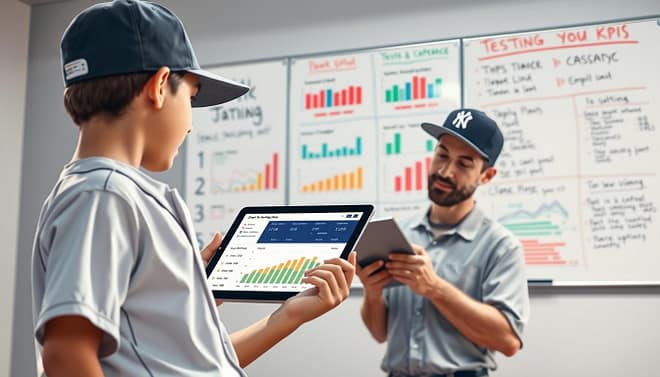
Video Notes: The Mirror With a Mute Button
Film doesn’t lie. But without the right context, it can be a weapon. The development-focused use of video is collaborative, not critical.
Instead of a highlight reel set to pump-up music, create a 30-second “learning clip” after each game. The rule? The player picks the clip and narrates what they see. The adult’s job is to ask one open-ended question: “What’s one small adjustment you might try next time?” This turns video review into a problem-solving session, reinforcing that the athlete owns their learning.
Simple KPIs: The Signal in the Noise
You don’t need a TrackMan to measure what matters. These three metrics give you 80% of the insight with 0% of the overwhelm.
| KPI | What It Measures | The Development-Focused Question |
|---|---|---|
| Exit Velocity (EV) | Hitting power and quality of contact. | “Were your hardest hits on pitches in your zone?” (Quality over raw power) |
| Command % | A pitcher’s ability to locate pitches. | “What was your go-to pitch in a 3-ball count?” (Mental approach under pressure) |
| Swing Decisions | Pitch selection and discipline. | “How many ‘pitcher’s pitches’ did you take?” (Process over outcome) |
The magic isn’t in collecting the data. It’s in the conversation that follows. A results-obsessed parent sees an 0-for-4 with two strikeouts. A process-focused adult sees the four hard-hit balls and the two swings at borderline pitches that, with a slight adjustment, become takes.
The Feedback Firewall: Scripts for the Stands
Here’s the operational manual for the adults. Consider it a growth mindset playbook.
The Post-Game Script (The 24-Hour Rule):
- Immediate Reaction (0-2 hours): “I love watching you play.” Full stop. No baseball talk.
- Cool-Down Review (Next Day): “What’s one thing you felt really good about out there?” Let the player lead. Your follow-up: “What’s one thing you’re curious to work on before next time?”
The Coach-Parent Boundary: Establish a clear firewall. The paid coach handles technical adjustments. The parent’s role is unconditional support and logistics. If you’re dissecting mechanics on the drive home, you’ve crossed the wire. The script for that? “That’s a great question for Coach Alex at your next session.”
This isn’t about being passive. It’s about being strategic. You’re creating a container where struggle is safe, effort is celebrated, and the player’s internal motivation—not your external pressure—fuels the journey. The car ride home should feel like a debrief with a trusted ally, not a performance review with a hostile manager.
Ultimately, measuring growth in a development-focused model means tracking the maturation of the athlete’s relationship with the game itself. Are they becoming students? Are they resilient? The most important KPI might just be the smile on their face when they talk about practice. Everything else is just data.
Parent/coach roles: feedback scripts and boundaries
You have the data. The swing decisions, the command charts, the exit velocity numbers. This isn’t just trivia. It’s your passport out of the spectator seats and into the front office of your player’s career.
Forget being a passive consumer of glossy brochures. Your new title is Auditor-in-Chief. Your mission is to evaluate a youth baseball program’s culture against the hard metrics we’ve outlined. Does their practice design prioritize constraints-led drills and small-sided games? Or is it a parade of repetitive, closed-circuit exercises?
Listen to the coaching language. Is it saturated with references to movement quality and throwing health—the six pillars? Or is the dialogue fixated on standings and tournament seeds? Your feedback scripts need to reflect this shift. Move from generic praise to specific, pillar-based observation.
Set financial boundaries with the precision of a big-league GM. Demand transparency in the cost structure. Are there hidden fees for “showcase events” or mandatory gear? A development-focused program has nothing to hide.
This is your ultimate scorecard. Take it to the next parent meeting or tryout. Use it to ask direct questions. This single sheet of paper is a more powerful BS detector than years of sideline gossip. It transforms you from a hopeful funder into an informed, strategic partner in the only process that matters: long-term athlete development.
You’ve earned your degree. Now go audit the world.