Forget the leisurely stroll. Getting to a college diamond is a high-stakes game, like chess. It’s your personal Moneyball sequel, where data meets destiny.
Before dreaming of packed stadiums, ask: Are you a college-level player yet? Good marketing can’t hide a bad product. The real recruiting timeline starts with checking your skills.
Your “Personal Baseball Equation” is key. It’s a tough calculation that weighs location, academic fit, and scholarship goals. Knowing NCAA rules and your place in them is the first step.
Choosing a school is strategic, not just about fan loyalty. It’s about building the player and launching the campaign. For more on planning for success, check out this guide on college placement in youth baseball. Let’s see the whole board, not just the pieces.
Freshman–Senior checklists (academics, camps, showcases, skills goals)
The recruiting checklist is more than a to-do list. It’s a detailed plan that helps you navigate high school. It turns your dream of playing college ball into a focused strategy.
Without a checklist, you’re just making it up as you go. Trying to succeed in the NCAA without a plan is like making a silent film for Netflix. You need a clear plan for each year of high school.
Your plan has two main parts: keeping up with schoolwork and improving your sports skills. If you ignore schoolwork, your sports skills won’t matter.
The “Top 5 Strengths and Weaknesses” list is not just a report card. It’s your Player Development Game Plan. It’s like a tech startup’s goals, guiding your off-season training and showcase prep.
Camps and showcases are not just for fun. They’re important meetings where you show off your skills. You only go when you’re ready.
Now, let’s look at your quarterly goals. Here’s your detailed plan:
- Freshman Year: The Foundation Pour. Your main goal is to be eligible. Focus on your academic core courses like a CPA. On the field, aim to join the top team and start building your skills goals.
- Sophomore Year: The Framework Goes Up. You’ll take harder classes. Work with your guidance counselor to keep your transcript in order. Athletically, refine your skills and start looking for camps to test yourself.
- Junior Year: The Interior Design. This is your showcase year. Show off your hard work. Take the SAT/ACT and make sure you meet NCAA requirements. Every game is a chance to impress.
- Senior Year: The Final Walk-Through. Now, it’s time to put your plan into action. Finalize visits, answer coach questions, and negotiate offers. Make sure all your paperwork is in order. Focus on perfecting your skills before college.
The key is your academic core courses and your Development Plan. Camps and showcases are like open houses. You build the foundation first, not the open house. This checklist helps you stay on track.
Building a target list and contact strategy; sample emails/DMs
Your recruiting strategy relies on two key documents. You need a detailed school list and a series of messages that stand out. This is where dreams meet cold-eyed realism. We’re moving from planning to action.
Think of your target list like a world map. You need allies at every level. A list only of top-25 D1 programs will likely get you ignored. A good list has areas for growth, stability, and backup plans.
Build your list across all divisions—D1, D2, D3, JUCO, NAIA—using a three-tier system:
- Dream Schools (Diplomatic Outreach): These are your reach programs. Your skills match theirs, but it’s a long shot.
- Likely Allies (Strategic Negotiation): The heart of your list. You fit well with their needs and standards. You have real bargaining power here.
- Safety Treaties (Secure Agreements): Programs where you’re a better fit than they need. They’re your sure bets. Don’t ignore them; they give you leverage.
With your list in hand, you move to diplomacy. A coach’s inbox is full of generic messages. Your goal is to send a clear, compelling message.
Your coach emails aim to start a conversation, not just brag about yourself. Take a cue from Matt Williams. He congratulated the coach on a win before talking about himself. It was smart and human.
His approach is a lesson in communication:
Subject Line: Personal and specific (e.g., “Question from a [Your High School] LHP – Congrats on [Specific Achievement]”).
Opening Line: A genuine compliment or recognition of a recent team event.
The Pitch: Two, maybe three, bullet points on your key stats/accolades. Link to your video.
The Ask: A clear, low-pressure request: “I will be in your area on [Date]. Would a 10-minute phone call be possible?”
This structure shows respect for the coach’s time while highlighting your skills and initiative. It’s a perfectly crafted policy brief.
Timing and follow-up are key to diplomacy. Send emails when coaches are likely to see them. If no response in 10-14 days, a polite follow-up is okay. Mention your previous email. The goal is to nudge, not spam.
Combine a realistic target list with a sharp email strategy. You’re not just another name. You’re a student-athlete starting a conversation. That’s how you turn a crowded inbox into an open door.
Video standards: 60–90 sec skills reel + game clips; hosting & links
Think of your highlight video as the trailer for your own biopic. If it doesn’t grab attention in the first ten seconds, it’s a flop. It’s not just for grandma’s birthday. It’s your campaign ad in a world where every coach’s inbox is a battleground for attention.
You’re competing with TikTok, Netflix, and the endless scroll. Your reel must be a precision strike. It’s your chance to shine in a crowded field.
The modern standard is a merciless 60 to 90 seconds. That’s it. This tight window forces a narrative. Start with your most explosive play—a no-doubt home run, a laser from the outfield.
Show your swing from multiple angles. Show your throwing motion. Show your athleticism in the field. Edit with the rhythm of a great pop song, not a meandering jazz solo. Every cut should serve the story: you are a ballplayer.

But here’s the non-negotiable part: the “highlight” reel is only half the story. You must include raw, unedited game clips immediately after. Consider these your C-SPAN footage. They are the sworn testimony that proves your edited magic is real.
A coach needs to see the at-bat before the home run. They need to see the routine grounder you field cleanly under pressure. This raw footage validates the sizzle of the reel.
Where you host this visual manifesto is critical. Your Instagram feed or TikTok profile is not a professional portfolio. Coaches want a clean, direct link that works every time. Use platforms built for this:
- YouTube: Universal, reliable, and easy to embed. Create a dedicated “Athlete” channel.
- Hudl: The industry standard. It speaks the language of recruiters directly.
- Google Drive or Dropbox: Simple, but ensure permissions are set to “anyone with the link can view.”
A dedicated hosting page looks professional. It tells a coach you take this seriously.
That link is your most valuable digital asset. It should be the crown jewel of every email and DM you send. Remember the template from section three? The line “click this link: SKILL VIDEO LINK” isn’t a suggestion. It’s the entire point.
That hyperlink is the gateway. Make sure it’s prominent, clickable, and leads directly to your best work. Don’t bury it in a paragraph. Give it its own line. Bold it.
Your highlight video is more than a collection of clips. It’s a visual argument. It’s proof of concept. A shaky, overlong, or poorly hosted video screams amateur hour.
A sharp, concise, and professionally presented reel whispers “next-level prospect.” In the attention economy, you don’t get a second chance to make a first impression. Make those 90 seconds count.
Campus visits, questionnaires, prospect days; money talk basics
Think of your first campus visit as a mission to gather information, not souvenirs. It’s where you move from being a digital profile to a real person. The unofficial visit is key for doing your homework.
This is a critical point in your recruiting timeline. You’re not just looking at dorms. You’re checking the program’s culture, facilities, and your role in it. You want to see if the school lives up to its promises.
Approach the day like a journalist. Observe everything. How do players interact with coaches? Is the weight room used or just for show? Take mental notes. This is your chance to gather facts.
Use the “30 Really Good Questions” as your tool. Don’t just ask about the mascot. Ask about roster strategy, financial details, and your future. Focus on three main areas:
- Roster & Playing Time (#23): “Where do you see me fitting into your positional depth chart in my freshman year?”
- Program Needs (#3-5): “How many players are you recruiting at my position for my class, and what is the immediate team need?”
- Scholarship Strategy (#17-20): “What is your typical scholarship allocation process for incoming freshmen?”
Asking these questions shows you’re engaged and thinking like a college athlete. It also moves your recruiting timeline forward with clarity.
Now, let’s talk about athletic scholarships. It can be awkward. But let’s make it clear.
First, baseball is an equivalency sport. Only 11.7 scholarships are split among a whole roster. Full rides are rare. Most offers are partial. Understanding this is key to your recruiting timeline and expectations.
Second, know the difference between an offer and a promise. A verbal offer isn’t binding. A written offer, like a National Letter of Intent (NLI), is. Until you have something in writing, stay cautious and keep your options open.
How do you have “the talk”? Start by understanding, not demanding. After building rapport, you might ask, “Can you walk me through how scholarship decisions are made for my recruiting class and when those are typically finalized?” This shows you understand the big picture.
Don’t forget the formal steps. Fill out the online questionnaire on every target school’s athletics website. Prospect days are group tryouts; use them to show your skills and see how they coach.
Mastering the visit and the financial conversation changes your journey. You become a strategic partner in your own future. It’s when your recruiting timeline becomes real.
Decision matrix: roster spot vs scholarship vs walk‑on
Choosing your college baseball team is more than picking a team. It’s solving a complex puzzle where your happiness is the goal. You face a puzzle that would make an economist think twice.
Is a spot on a famous D1 team worth it, even without money? Or is a 25% scholarship at a D2 school better? Or maybe a walk-on spot with a coach’s promise of “something later”? You need to weigh your options carefully.
Your main goal is the “Personal Baseball Equation.” It focuses on Cost and Level. Cost means more than just tuition. It includes the total financial impact on your family. Level is more than just the division. It’s about the competition and your growth.
Now, add other important factors:
- Early Playing Time: Will you play right away or sit on the bench?
- Coaching Stability: Is the coach’s job secure? A change can affect everything.
- Academic Fit: Does the school offer your major? What’s the graduation rate?
- The Cold Calculus of Debt: Is taking on $80,000 in loans for a famous school worth it if you’re not playing?
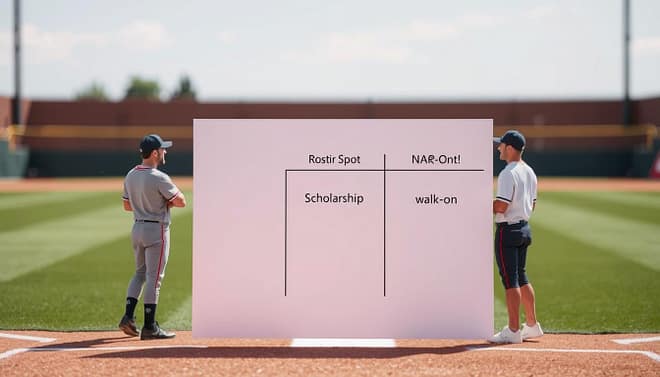
Your decision must consider NCAA rules. Baseball is an equivalency sport. Full scholarships are rare, often split among many players. D1 programs have 11.7 total scholarships, D2 have 9.0. This means partial offers are common.
A “walk-on” isn’t just a tryout. Under NCAA rules, a preferred walk-on has a guaranteed spot but no money. A regular walk-on tries out for the team. Know your rights.
Do you want to be a small fish in a big pond or a big fish in a small pond? The big school might offer great facilities and exposure. But if you’re not playing, that exposure is just cheering. The smaller school might offer more playing time and a chance to build a legacy. Which is better for you?
Questions #17-20 are key here. What’s the duration of the scholarship? Is it for one year or four? Are there conditions for renewal? Ask about roster cuts too. Programs can cut players. Is your spot safe, or are you just insurance? A “promise” isn’t binding; a written offer is.
The best offer isn’t always the shiniest. It’s the one that fits your personal goals for success, development, and sanity. A partial scholarship at the right school might be better than a vague walk-on spot at your dream school. Your decision isn’t about baseball or life. It’s about finding a school where baseball and life can grow together, within NCAA rules and your family’s reality. Run the numbers. Then trust your gut.
Family calendar and budget tool
Think of the recruiting chase as a family-funded startup. Every startup needs an operational manual. This is yours.
The family calendar is your master timeline. Plot showcase seasons against ACT/SAT dates. Pin the NCAA eligibility center deadlines in red. Your eligibility is built, brick by brick, on completing your required academic core courses. Missing a deadline here isn’t a simple oversight; it’s a political scandal you can’t afford.
Then, the budget tool. Remember the “Cost” factor from your personal equation? This is where it gets real. Project expenses for travel, elite camps, and application fees. Most importantly, model the tuition gap—the difference between a scholarship offer and the full cost. This isn’t about pessimism. It’s about managing family resources with the cold precision of a CFO, ensuring the pursuit of a baseball dream doesn’t morph into an unwanted financial thriller.
These two tools transform hopeful chaos into a structured campaign. They are the post-credits scene that properly sets up the sequel: your actual college career. Now go execute the plan.