The “more is better” myth in sports is like a bad Netflix show. You know it’s harmful, but you can’t stop watching. Our approach is different. It’s about intelligent stimulus, not overworking young athletes.
It’s like applying physics to the growing body. The right amount of force, at the right time, through the right parts. This starts with a solid base: movement quality. You can’t build a strong structure on shaky ground.
Using the right amount of weight is key. A 14-year-old’s body is not just a smaller adult’s. It’s a unique, growing system. And rest is not laziness. It’s where real growth happens.
Research shows that training too much doubles the injury risk for young athletes. This isn’t about doing less. It’s about doing it smarter. We aim to build strength, not exhaustion.
Year plan: off‑season build, pre‑season ramp, in‑season maintenance, post‑season unload
Periodization is like planning a show. It keeps a young pitcher from throwing too hard in bad weather. It’s a yearly plan that makes sure they’re ready for the start of the season. It’s like a four-part story for their body, each part with its own role.
Let’s break down the drama.
Act I: The Off-Season Build. This is the time to try new things. The games are not on yet. We work on getting stronger and better at moving, without the stress of games. It’s about becoming a better athlete, not just a baseball player.
Young athletes get stronger in a straight line with good exercises. It doesn’t matter if they’re 13 or 17; their bodies respond well to smart training.
Act II: The Pre-Season Ramp. Now we focus on baseball skills. We increase the intensity slowly. This phase gets them ready for the season. It’s also the time to pick the right equipment to match their training.
Smart equipment selection is key during this intense preparation.
Act III: In-Season Maintenance. Now, the games are the main focus. Training helps keep them strong and fresh. It’s a balance to avoid getting too tired or losing strength.
This is the heart of the in-season vs off-season contrast: building up versus keeping it going.
Act IV: The Post-Season Unload. This is not just resting. It’s active recovery and a mental break. It helps the body and mind relax after the season.
So, what’s the plan for this four-part story? Research shows us the way:
- Ages 12-15: 2-3 training sessions a week is best.
- Ages 16-18: They can do 3-4 sessions a week as they get older.
Make sure to include 1-2 full rest days. Games are stressful too. This structured approach to periodization helps young athletes grow without burning out. It makes sure they’re at their best when it counts.
Lifts that Transfer and Sprint Work: The Kinetic Blueprint
Forget about building beach muscles. We’re focusing on creating a kinetic chain that can launch a baseball into orbit. This part of your youth baseball strength plan is all about building raw, transferable force.
We focus on movement patterns, not just muscle size. It’s about building a body that can throw, hit, and run well. Bodyweight exercises are the safest and most effective way to start. Squats, lunges, push-ups, and pull-ups are key.

Next, we add resistance bands, medicine balls, and weights to challenge our movements. We aim for precision, not just doing a lot of reps. Even one good session a week can make a big difference.
Let’s look at the essential movement patterns and their roles in baseball:
- The Hinge (Deadlift Variations): This movement is the engine. It teaches power transfer from the ground up, just like in a swing or throw.
- The Squat: It’s the foundation of lower-body strength and stability. It’s not about going too low for looks. It’s about building strong legs for power.
- Push/Pull (Presses & Rows): This balances the muscles around the shoulders. It keeps a young pitcher’s arm healthy and a hitter’s swing balanced.
- Anti-Rotation Work: This trains the core to resist unwanted motion during a swing or throw. It makes the core a stable powerhouse.
Progression is key. We start with mastering bodyweight movements. Can the athlete perform these movements flawlessly? Only then do we add weights. The focus is on perfect technique, not just lifting heavy.
Sprint work is where strength meets speed on the basepaths. It’s the most baseball-specific power metric. Plyometrics and speed training are essential. They teach the body to express its strength at game speed.
Postpubertal athletes respond well to this structured plan. Their bodies are ready to convert strength into faster, quicker movements. The weight room work fuels the sprint work.
So, ditch the bodybuilding approach. A smart youth baseball strength plan is a blueprint for athleticism. It builds the hinge, squat, push/pull, and anti-rotation core. Then, it teaches the body to fire at full speed. That’s how you build an athlete.
Arm‑care circuits and thrower’s shoulder/scap routine
Volume is a big problem for young pitchers, making arm care a must. Injuries like Little League elbow and medial epicondyle apophysitis are common. They happen when pitchers throw too much without preparing enough.
The throwing motion is both flexible and stable. It needs the shoulder to move like a rubber band and then stop like concrete. If this balance is off, the elbow pays the price.
The scapula, or shoulder blade, is key. It must move right for the shoulder and elbow to work well. Without good scapular movement, the body can’t handle the throwing motion.
Arm care isn’t just a few stretches after practice. It’s a major part of training, as important as a good fastball. It’s like daily care for a pitcher’s arm.
Here’s the core of the insurance policy:
- Scapular Retraction & Depression: Rows and pull-downs help the shoulder blades move right. This makes a strong base for throwing.
- Rotator Cuff Focus (External Rotation): The rotators work hard with every throw. But the external rotators are often ignored. Strengthening them helps balance the arm.
- Sleeper Stretches: This stretch keeps the shoulder mobile. It helps prevent tightness that can hurt the elbow.
The research is clear: volume is a big problem. If you want your arm to perform, you must prepare it. This routine is that preparation. It helps prevent injuries from too much throwing.
Make this circuit a must in your training, during busy periods. It’s a smart investment. The reward is a healthy arm that performs well when it matters most.
Sample 2‑day and 3‑day templates with progressions
Theory is for textbooks. But, Monday at 4 PM is where the real work happens in any youth baseball strength plan. Let’s turn those movement patterns into a weekly schedule you can follow.
For 13-15 year olds or in-season athletes, two full-body sessions a week is best. It builds strength without making them tired all the time. For 16-18 year olds in the off-season, three days a week lets you focus more on specific areas. Remember, a regular strength program does more than build muscle. It also strengthens young bones against the stress of playing baseball.
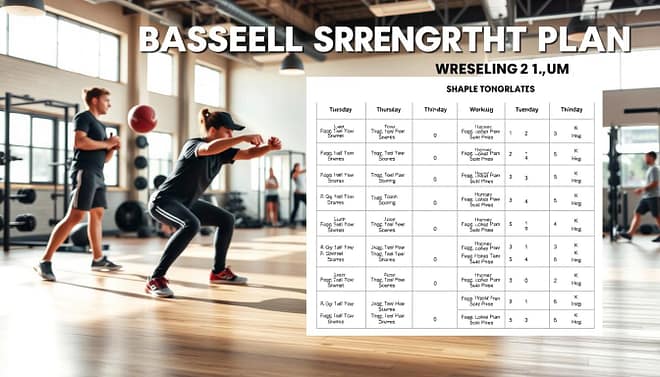
Here’s a simple plan for younger or busy athletes. It’s like a minimalist’s guide: hit all the main points, then stop.
| Day | Primary Movement | Exercise & Progression Path | Sets x Reps | Integrate This |
|---|---|---|---|---|
| Monday | Hinge & Pull | Goblet Squat → Front Squat Band-Assisted Pull-Up → Bodyweight Pull-Up |
3 x 8 | Arm-Care Circuit (Post-workout) |
| Thursday | Push & Anti-Rotation | Push-Up → Dumbbell Bench Press Pallof Press → Cable Chop |
3 x 10 | Linear Sprints (Pre-workout dynamic warm-up) |
| Notes | Focus on technique over load. The progression (e.g., goblet to front squat) happens over weeks, not days. Weave in 10 minutes of sprint work after a dynamic warm-up on Day 2. Finish each session with the 8-minute arm-care circuit from Section 4. | |||
This template isn’t static. It’s a living document. When an athlete masters the goblet squat with perfect form for three weeks, you introduce the front squat rack position. That’s progressive load in action—advancing the stimulus as competency grows.
Now, for the older teen with more developmental runway. The three-day split permits a deeper dive, often structured as an upper/lower/full-body rhythm. Volume increases, but so does recovery responsibility.
| Day | Focus | Key Exercises & Progressions | Sets x Reps | Strategic Adds |
|---|---|---|---|---|
| Day 1: Upper | Strength & Scap Health | DB Bench Press → Barbell Bench TRX Rows → Bent-Over Rows External Rotation w/ Band |
4 x 6-8 | Thrower’s Ten (as warm-up) |
| Day 2: Lower | Power & Stability | Front Squat → Back Squat Romanian Deadlift Box Jump → Depth Jump |
3 x 5, 4 x 8 | Lateral Sprints & Decels |
| Day 3: Full Body | Integration & Conditioning | Sandbag Clean & Press Split Squats Farmers Walk |
3 x 10 | Full Arm-Care Circuit |
| Notes | Progressions here are about complexity and load. Depth jumps replace box jumps only after a foundation of landing mechanics is bulletproof. The arm-care and scap work aren’t add-ons; they’re baked into the upper day warm-up and full-body day finisher. | |||
The magic isn’t in the template itself, but in the progression pathways embedded within it. Moving from band-assisted to bodyweight pull-ups isn’t just about back strength. It’s about graded exposure that strengthens tendons and bones. That’s the real win of a smart youth baseball strength plan.
Now, for the older teen with more developmental runway. The three-day split permits a deeper dive, often structured as an upper/lower/full-body rhythm. Volume increases, but so does recovery responsibility.
These templates are skeletons. You flesh them out by seamlessly stitching in the arm-care circuits and sprint work we’ve already detailed. The result? A unified system where strength training, injury prevention, and on-field speed don’t just coexist—they synergize. Now, you’re not just following a workout; you’re executing a plan.
Nutrition/sleep for teens; growth‑spurt precautions
Imagine your youth baseball strength plan as a high-performance engine. But if you fuel it with gas station pizza and only five hours of sleep, it’s like racing a Ferrari on watered-down fuel. For teenage athletes, nutrition is key for growth, and performance is a bonus.
Don’t fall for the supplement trap. Stick to the basics: enough protein for repair, quality carbs for energy, and hydration. When you’re more active than usual, you need more fuel.
Sleep is the ultimate free performance booster. It releases growth hormone and helps solidify practice in your brain. A study shows strength training can even improve sleep quality in teens, creating a positive cycle.
Then, there’s the growth spurt. Limbs grow overnight, coordination drops, and injury risk goes up. This is when a smart youth baseball strength plan gets flexible. Simplify, reduce intense jumps, and focus on mobility and control. This approach aligns with foundational training principles that prioritize health and performance.
The real victory isn’t just a stronger athlete. It’s a healthier, more durable, and confident one.