Let’s be honest – “student-athlete” often feels like a contradiction in youth sports. Travel tournaments trump trigonometry. Fastballs overshadow finals.
This program cracked the code. They treat academics not as an obstacle but as athletic success’s fundamental partner. It’s Moneyball meets Montessori – exit velocity and GPA carry equal weight.
Their 93% college placement rate isn’t accidental. It’s engineered through NCAA compliance workshops and personalized academic tracking. They operate on a radical notion: homework completion might actually improve batting averages.
Take AJ Smith-Shawver’s MLB debut. It happened because of his academics, not despite them. Scouts want complete individuals who handle both seventh-inning pressure and organic chemistry.
This isn’t just another baseball club. It’s where academics and athletics stop fighting and start working together.
School Support Strategies
Imagine if your child’s baseball program made algebra as important as their batting average. Texas Stix does just that. They blend academics with sports, making it a core part of their program.
The club uses an “academic shift defense” system. They plan study times around tournaments, just like fielding positions. It’s smart and effective.
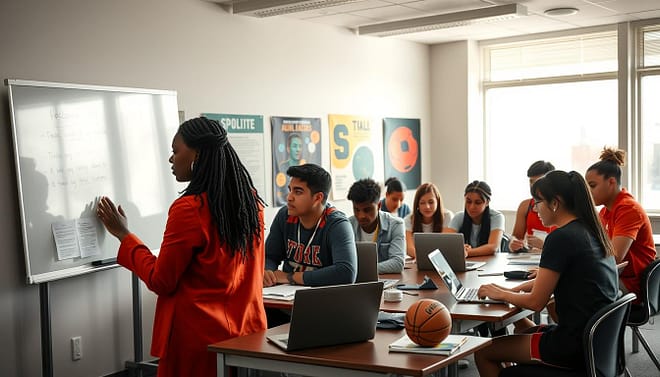
They track grades like they measure fastball speed. This approach helps students grow both in school and sports. They can even discuss economic policy between innings.
Here’s how their system works:
| Academic Component | Athletic Parallel | Implementation |
|---|---|---|
| Mandatory Study Halls | Bullpen Sessions | Scheduled during travel tournaments |
| Custom Lesson Plans | Individual Drills | Synced with game schedules |
| Video Review Sessions | Swing Analysis | Covers both essays and mechanics |
| Performance Metrics | Stat Tracking | Grades and athletic stats weighted equally |
NCAA compliance workshops are cleverly done. They’re not boring. Instead, they teach students to see academic rules as challenges to win.
Personalized plans are a key part of their program. Each player gets a plan that focuses on their strengths and weaknesses. It’s like a game plan for school.
Teachers and coaches work together. They suggest “academic pitching changes” to help students learn in new ways. It’s a way of thinking that would impress even the greatest thinkers.
Texas Stix shows that you don’t have to choose between school and sports. The discipline needed for sports can also help in school. That’s a complete win.
Balancing Practice and Homework
Travel ball programs often look at batting averages to measure success. But Stix focuses on something more important: how well players do their homework. Their secret is not just better bats. It’s their smart scheduling that impresses.
The program requires a 10-12 hour weekly commitment. It’s like a clock that never stops. Practice times are set around exams. Video sessions are also study groups. Even travel plans include homework time with good WiFi.

Players like Drake Hawpe work on calculus between batting practice. It’s not just doing two things at once. It’s training their minds to focus like they do in big games.
Their system is based on three main ideas:
- Temporal arbitrage – finding the best times to work
- Cognitive asset allocation – switching between mental tasks
- Integrated scheduling – mixing school and sports plans
College scouts see this discipline. Doing homework shows a player’s dedication and time management skills. It’s more than just hitting home runs.
Players learn to see the world in patterns, just like in sports and science. It’s not just about balance. It’s about being excellent in all areas of life.
Time Management Tips
Managing a pitching rotation is tough. Try adding teenage sleep cycles, calculus homework, and weekend tournaments to the mix. Texas Stix tackles this challenge with the precision of a chess grandmaster.
They use Temporal optimization that impresses even Silicon Valley experts. It’s like Moneyball for time management, focusing on high-value hours.
Student-athletes learn to treat their schedule like a lineup card. They use prime mental hours for tough subjects and physical training when they’re most energetic. It’s about being smart, not just working hard.
Here’s how their system works:
- Energy-based time blocking: Tasks match their energy levels
- Academic-athletic integration: School and sports schedules align
- Focus techniques: Baseball methods help with studying
- Recovery optimization: Rest is built into the schedule
One player said, “I focus on reading pitchers like I do Shakespeare. It’s all about patterns and discipline.”
The results are clear. Texas Stix athletes keep high GPAs while competing at top levels. They treat time management as seriously as swing mechanics.
| Time Slot | Traditional Approach | Texas Stix Method | Performance Impact |
|---|---|---|---|
| 6-8 AM | Extra sleep | Light study session | +15% retention |
| 3-5 PM | Practice only | Skill drills + review | +20% efficiency |
| 7-9 PM | Homework marathon | Focused blocks + breaks | -30% stress |
| 9-10 PM | Screen time | Recovery & planning | +25% readiness |
This isn’t just theory; it’s a proven strategy. Players discuss their Pomodoro technique with the same excitement as batting stances. These skills improve their performance on the field.
The key takeaway? Great time management is a valuable skill for student-athletes. It’s what sets good players apart from great ones, in school and in sports.
Student-Athlete Success Stories
Most programs focus on batting averages and ERAs. But Texas Stix looks at acceptance letters and academic honors. It’s amazing to see a kid who can spot a slider’s spin and solve math problems before dinner.
AJ Smith-Shawver’s story is inspiring. His MLB debut with the Atlanta Braves was big news. But his real success was in calculus classes. While scouts watched his 98 mph fastball, teachers saw him on the honor roll.
Cash Clayton’s Division I commitment is another example. He got athletic and academic scholarships. This shows that elite athletes can also excel in school.
Parents share stories of how baseball training helped their kids. One mom said her son’s baseball skills helped him understand Shakespeare. Another mom talked about how her daughter did homework on bus rides.
These stories are not unique. They show a program that values academic performance as much as athletic. The key is to be focused but also well-rounded.
Texas Stix shows that important stats can be found on a transcript, not just on the scoreboard.
Communicating with Coaches and Teachers
Most youth sports programs struggle with communication between coaches and teachers. It’s like trying to solve a diplomatic crisis. Texas Stix has changed this into a smooth feedback loop, like a Silicon Valley startup.
They make sure academic performance is just as important as sports skills. I’ve seen coaches and teachers work together, improving both sports and schoolwork. It’s amazing to watch.
Academic meetings are like war rooms for student success. If a student struggles in chemistry, they get help just like a sports player. They know that solving math problems helps with sports too.
This approach is the future of helping students succeed. Texas Stix shows that when coaches and teachers work together, everyone benefits. Young athletes do better in school and sports.