Let’s retire a tired old myth, shall we? The “dumb jock” stereotype is outdated, like a wooden baseball bat in today’s games.
The truth is, being good at sports and doing well in school aren’t opposites. In fact, the best programs see them as a strong team.
This isn’t just a nice idea. It’s backed by data, showing holistic development. The aim is to make well-rounded people, not just sports stars.
Putting academic balance first isn’t giving up on sports. It’s key to a lasting career in athletics. Studies on top sports schools prove this approach works wonders.
It shapes a young person’s future, beyond just sports. We’re talking about growth in work, health, social skills, and mental well-being.
The old way forced a tough choice: school or sports. But top academies now focus on the synergy between the classroom and the diamond. This is at the heart of good student athlete support.
Why School Comes First
The “school comes first” mantra is more than a slogan. It’s a smart way to manage risks for young athletes. Think of your body as an investment. Focusing only on sports is like putting all your money in one stock. But, investing in your mind is like diversifying your portfolio for life.
Studies on holistic athlete development show the benefits. Students in structured dual-career environments do well. They learn to cope better and stay mentally healthy. This is because their identity isn’t tied to just one game.
This is what true academic balance is all about. It’s the difference between being “a baseball player” and being someone who plays baseball. The first faces a crisis with every loss. The second sees it as a challenge to overcome. This mental safety is invaluable.
This balance creates three key safety nets:
- Academic/Vocational: This is your 50-year plan. A sports career is short-lived. Your education is your long-term foundation.
- Psychosocial: School connects you to the world beyond sports. It helps you develop social skills and a network not based on sports.
- Psychological: Having an identity outside sports protects against burnout and anxiety. It gives you perspective when sports get tough.
So, prioritizing school isn’t about giving up on sports. It’s about making a smart investment. You’re building intellectual capital that grows over time. This balanced approach makes you more than just a sports star. It makes you resilient and multi-dimensional. The data shows that athletes with a strong education do better in life.
Time Management Tips
Forget color-coded binders; real student athlete support means checking every 15-minute gap in your day. Your time isn’t empty. It’s filled with classes, lifts, film sessions, and bus rides. The goal is to manage it well.
Let’s tackle the Sunday Scaries. That feeling of dread about the week? We turn it into planning. Use a blank weekly template to plan out your time. Fill in the must-do’s like school and practice. Then, use the leftover time for other things.
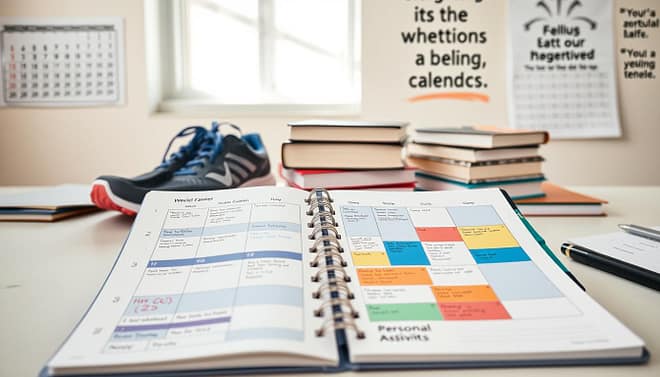
Now, the real strategy starts. See a 15-minute gap between lunch and study hall? Most people scroll. You solve a calculus problem. This is “found time.” Using it wisely is like throwing a slider in a key situation.
We use the 40-10 method for studying. Work intensely for 40 minutes, then take a 10-minute break. This isn’t just a Pomodoro technique. It’s training your brain for focus and recovery, like your sport.
This rhythm is key for student athlete support. It shows that long study sessions don’t work for you. Your brain needs to work in bursts, like your sport.
Schools offer flexible scheduling to help. Imagine your day isn’t set in stone. A two-hour practice block can fit around a morning lab. This flexibility is your safety net, helping you build a personal system.
So, what does this look like in practice? Below is a breakdown of the core techniques. Think of it as your playbook for the week.
| Technique | How It Works | Primary Benefit |
|---|---|---|
| Sunday Planning Session | Map the entire week in one 30-minute sit-down. Identify all fixed commitments and highlight “found time” pockets. | Turns weekly anxiety into actionable clarity. Provides a macro view. |
| The 40-10 Study Method | Work with total focus for 40 minutes, followed by a strict 10-minute physical or mental break. Repeat. | Builds mental endurance and prevents burnout. Aligns with athletic training cycles. |
| Found Time Utilization | Aggressively use any gap of 10+ minutes (e.g., post-practice, before transport) for a single, small task. | Transforms dead time into productive momentum. Reduces evening workload. |
| Flexible Block Scheduling | An institutional framework where academic and athletic blocks can be adjusted dynamically. | Provides the structural support needed for individual time management to thrive. |
The last tip? Build buffers for chaos. Schedule in 15-minute “void” blocks after practices and before trips. The bus will break down. A teacher will run late. This buffer is your shock absorber. It’s the difference between a plan that shatters and one that bends.
True time management isn’t about doing more. It’s about focusing better with the time you have. It’s the ultimate form of student athlete support—giving you the tools to own your schedule, instead of letting it own you.
The Academy’s Approach to Homework
Young athletes learn more than just sports at IMG Academy. They see algebra as a sport, too. The academy’s support system is like a team that helps students overcome challenges.
Imagine a team building a support system around each student. Personalized advisors know all about NCAA rules. They help students stay on track, not just catch up.
The Learning Resource Center is like a team’s practice space. Students can work on tough problems here. Teachers are always ready to help, making sure small issues don’t turn into big problems.
Academic managers even go on team trips. This shows that schoolwork is just as important as sports. The classroom stays with the team, no matter where they go.
This approach includes:
- College counseling that starts early, framing high school coursework as part of a longer play.
- Continuous grade monitoring to maintain eligibility, treating it as a non-negotiable stat.
- Tutoring that’s embedded in the daily schedule, not an add-on for those struggling.
Homework is treated like a game at IMG Academy. The academic balance is a team effort. It’s part of the Academy’s strategy, executed with precision.
Study Spaces at the Facility
Forget the chaos of studying on a team bus. The Academy creates quiet spaces instead. That image of an athlete studying under stadium lights? It’s a sign of poor planning, not pride.
Environment affects your mind a lot. Your brain needs certain signals. A quiet study area at our facility means it’s time to work.
It’s not about fancy chairs. It’s about making things easy. We have quiet spaces for studying, just like Source 1 suggests.
Our Learning Resource Center and other areas are made for focus. They create a quiet space for studying. This space is a place where students can focus without distractions.

This is the power of the “third space.” It’s not home or school. It’s a special place for studying.
Let’s look at how it helps. The table below shows the difference our space makes.
| Study Scenario | Noise Level & Distractions | Mental Shift Required | Time Wasted on Setup | Symbolic Value |
|---|---|---|---|---|
| Hotel Lobby / Team Bus | High, unpredictable | Extreme (chaos to focus) | Significant (finding a spot) | Academic work is an afterthought |
| Dorm Room | Moderate, familiar distractions | Medium (competing cues) | Low | Blurs leisure and work |
| Academy-Designed Space | Low, controlled | Low (environment cues focus) | Minimal (ready to go) | Academic work is a core, respected part of the process |
See the difference? The right place to study boosts your effort. It gives you a mental edge, like a home-field advantage.
This small change has a big impact. It shows athletes that their brains are important. It makes studying easier and leads to better grades and discipline.
Collaboration With Local Schools
The most important partnership for a student-athlete isn’t on the field. It’s between their academy and local school. We’ve seen talented kids trying to manage two worlds alone. This is doomed.
True academic balance means these places work together. They shouldn’t fight over a student’s time.
Aligning school and sports schedules is key. It’s like setting up a treaty before a big game. Will a big project be due after a win? Planning ahead is essential.
Elite sports schools around the world do this. They adjust schedules and offer extra lessons with the school’s help.
Good communication is the heart of this partnership. Teachers, coaches, and parents need to talk clearly. This stops small problems from growing big.
Today, we use digital tools to share information. Schools and academies can see assignments and grades together. This helps everyone stay on the same page.
Regular meetings between advisors and coaches make sure students are supported. This way, students can focus on learning and sports, not just getting by.
This teamwork is what keeps students safe from stress. It lets them be students and athletes, not just diplomats. This partnership is the backbone of academic balance in real life.
Conclusion: Student Athletes Excel Here
Does this model of student athlete support really work? The answer is a clear yes. High GPAs and college placements show its success. This stands out against failures where academic balance and welfare are ignored.
A report from the University of Texas Libraries shows the dark side of some international academies. Exploitative conditions lead to a power imbalance, neglecting the mind’s importance.
Our academy takes a different path. It rejects the idea that success comes at the cost of others. The “excel” in our headline means more than just getting into college. It’s about becoming a well-rounded person.
Student-athletes here are not just hybrids. They are fully formed individuals. They’ve learned discipline and how to balance school and sports.
They also avoid the trap of being defined by just one aspect of their life. The most important statistic isn’t about sports. It’s about their overall growth and readiness for life after sports.