Benefits of Early Childhood Sports Programs
Early childhood sports programs offer numerous benefits for young children. These programs help in developing physical skills, such as coordination and balance, which are essential for overall health and well-being. By participating in sports, children can improve their fine motor skills, hand-eye coordination, and overall physical fitness.
Engaging in sports at a young age also promotes cognitive development. Children learn important life skills, such as teamwork, communication, and problem-solving. These skills are valuable not only in sports but also in everyday life, helping children become well-rounded individuals.
Participating in sports programs also fosters emotional growth. Children develop self-confidence, self-esteem, and resilience through their experiences on the field or court. They learn to handle setbacks, overcome challenges, and develop a growth mindset.
Early childhood sports programs provide a safe and supportive environment for children to explore their interests and passions. They offer opportunities for children to try different sports, discover their strengths, and find activities they enjoy. This helps in building a lifelong love for physical activity and sports.
By enrolling children in early childhood sports programs, parents can provide them with a well-rounded and enriching experience. These programs offer a unique combination of physical, cognitive, and emotional benefits that can have a lasting impact on a child’s development.
Benefits of Early Childhood Sports Programs:
- Development of physical skills, such as coordination and balance
- Improvement in fine motor skills, hand-eye coordination, and overall physical fitness
- Enhancement of cognitive development through teamwork, communication, and problem-solving
- Fostering of emotional growth, including self-confidence, self-esteem, and resilience
- Opportunities to explore interests and passions in a safe and supportive environment
Age-Appropriate Skill Development
Teaching sports to kids isn’t just about teaching—it’s about understanding how their brains work. You wouldn’t give a toddler a book like “War and Peace” and expect them to understand it. It’s the same with expecting kids to do complex sports moves too early.
Our beginner sports in Bryan program starts with this basic idea. We know that kids at different ages can do different things.
For kids aged 3-5, we focus on the basics. It’s like learning the alphabet before you start reading books. We teach them skills that might seem simple but are really important.
- Locomotor mastery: Running, jumping, and stopping without using a wall.
- Object control: Catching a ball and rolling it underhand.
- Spatial and social awareness: Knowing about personal space and sharing.
We break down sports into their simplest parts. Soccer is about kicking a ball towards a target. Basketball is about bouncing a ball with one hand. This way, kids can feel successful right away.
We measure success in smiles and willingness to try again, not just in winning. This approach helps kids avoid burnout and enjoy sports more.
This isn’t making sports easier. It’s making kids stronger. By teaching them at the right time, we help them feel confident and ready for more challenges later.
Teaching kids too much too soon is like putting them in a bootcamp class. It can confuse and scare them off from sports. Our Bryan’s beginner sports programs are designed to be the right start, not a step back.
We make learning sports like a video game with levels that match the child’s abilities. Each session adds a new skill. This makes learning fun and builds a love for sports that lasts a lifetime.
Motor Skills and Coordination Focus
Watch a three-year-old try a somersault, and it’s more than play. It’s the building of their nervous system. This is the heart of toddler athletics. We focus on the basic wiring of the human body.
Think of it like learning the alphabet before writing poetry. Kids need to master basic movements before they can play sports. Running, jumping, and throwing are like learning words in a movement language.
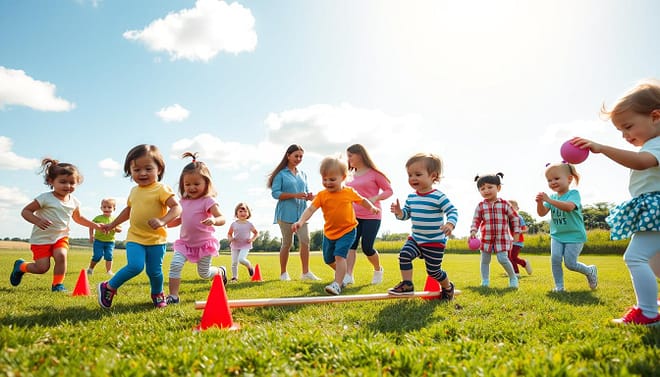
We act like movement anthropologists. We see a child on an obstacle course as a study. It tests their spatial sense and body awareness. It’s about knowing where they are and how to move.
Programs like Hula Hooping and balance beams are not just games. They help build strength and balance. This is the foundation for future sports skills.
So, what are we building? Let’s look at the details.
| Foundational Skill Focus | Observable Milestone | Long-Term Athletic Benefit |
|---|---|---|
| Gross Motor Development | Coordinated running, controlled jumping, safe landing. | Forms the power base for all field and court sports. |
| Dynamic Balance & Core Stability | Maintaining posture on one foot, navigating uneven surfaces. | Critical for gymnastics, dance, martial arts, and injury prevention. |
| Object Manipulation (Fine Motor) | Gripping a ball, aiming a throw, catching with hands. | Directly translates to throwing, catching, and striking skills. |
| Spatial Awareness & Proprioception | Navigating around others, judging distances, understanding personal space. | Essential for team sports agility and overall body control. |
| Bilateral Coordination | Using both sides of the body together (e.g., jumping with two feet). | Foundation for complex skills like swimming strokes or tennis swings. |
This method is simple yet powerful. We’re not focusing on perfect form. We create environments where kids can learn naturally. They’re not told to “engage their core.” They’re encouraged to reach for stars while balancing.
This approach to toddler athletics is wise. The goal is not to win but to build new connections in the brain. We’re creating the foundation, one step at a time, with joy and determination.
Benefits of Early Childhood Sports Programs
Early childhood sports programs offer numerous benefits for young children. These programs help in developing physical skills, such as coordination and balance, which are essential for overall health and well-being. By participating in sports, children can improve their fine motor skills, hand-eye coordination, and overall physical fitness.
Engaging in sports at a young age also promotes cognitive development. Children learn important life skills, such as teamwork, communication, and problem-solving. These skills are valuable not only in sports but also in everyday life, helping children become well-rounded individuals.
Early childhood sports programs also foster emotional development. Through sports, children learn to handle emotions, develop self-confidence, and build resilience. They learn to cope with both success and failure, developing a positive mindset and a growth mindset.
Participating in sports programs at a young age can also have long-term benefits. Research has shown that children who engage in sports at a young age are more likely to maintain an active lifestyle throughout their lives. This can contribute to a lower risk of obesity, improved mental health, and overall well-being.
Overall, early childhood sports programs provide a foundation for physical, cognitive, and emotional development. They help children develop essential skills, foster a love for physical activity, and set them on a path towards a healthy and active lifestyle.
Benefits of Early Childhood Sports Programs
| Benefits | Description |
|---|---|
| Physical Skills Development | Early childhood sports programs help children develop physical skills such as coordination, balance, and fine motor skills. |
| Cognitive Development | Participating in sports at a young age promotes cognitive development, including teamwork, communication, and problem-solving skills. |
| Emotional Development | Sports programs help children develop emotional intelligence, including handling emotions, building self-confidence, and developing resilience. |
| Long-term Benefits | Engaging in sports at a young age can lead to a lifelong commitment to physical activity, reducing the risk of obesity and improving mental health. |
FAQ
Q: What is the Bryan Sports Complex?
A: The Bryan Sports Complex is a state-of-the-art sports facility in Bryan, Texas. It offers a variety of sports programs and activities for athletes of all ages and skill levels.
Q: What sports programs are available at the Bryan Sports Complex?
A: The Bryan Sports Complex offers programs in basketball, baseball, softball, soccer, volleyball, and more. They also provide training programs for athletes looking to improve their skills.
Q: What is the Bryan Sports Academy?
A: The Bryan Sports Academy is a premier sports academy located within the Bryan Sports Complex. It offers specialized training programs for athletes looking to take their game to the next level.
Q: What is the Bryan Sports Center?
A: The Bryan Sports Center is a sports facility within the Bryan Sports Complex. It offers a variety of sports programs and activities for athletes of all ages and skill levels.
Q: What is the Bryan Sports Complex’s commitment to excellence?
A: The Bryan Sports Complex is committed to providing top-notch facilities and programs for athletes. They strive to create a supportive and competitive environment where athletes can reach their full athletic and personal development.
Q: What is the Bryan Sports Complex’s vision for the future?
A: The Bryan Sports Complex aims to continue growing and expanding its programs and facilities. They are dedicated to providing athletes with the best opportunities to succeed in their chosen sports.
Q: How can I contact the Bryan Sports Complex?
A: You can contact the Bryan Sports Complex by visiting their website or calling their office. They will be happy to provide you with more information about their programs and facilities.
Benefits of Early Introduction to Sports
Introducing toddlers to sports at a young age offers numerous benefits. It helps in developing their physical skills, such as balance, coordination, and strength. These skills are essential for their overall health and well-being.
Engaging in sports also promotes cognitive development. It enhances their problem-solving abilities, memory, and concentration. These skills are vital for their academic success and personal growth.
Participating in sports fosters social skills and emotional intelligence. Toddlers learn to work together, communicate effectively, and develop empathy. These skills are essential for building strong relationships and navigating social situations.
Playing sports helps toddlers develop a positive mindset and self-confidence. It encourages them to try new things, take risks, and overcome challenges. This mindset is beneficial for their personal growth and future success.
By introducing toddlers to sports early, parents can provide them with a solid foundation for a healthy and fulfilling life. It is important to choose age-appropriate sports and ensure a safe and supportive environment for their development.
Benefits of Early Introduction to Sports:
- Develops physical skills such as balance, coordination, and strength
- Enhances cognitive development, including problem-solving abilities, memory, and concentration
- Fosters social skills and emotional intelligence
- Encourages a positive mindset and self-confidence
Benefits of Early Childhood Sports Programs
Early childhood sports programs offer numerous benefits for young children. These programs help in developing physical skills, such as coordination and balance, which are essential for overall health and well-being. By participating in sports, children can improve their fine motor skills, hand-eye coordination, and overall physical fitness.
Engaging in sports at a young age also promotes cognitive development. Children learn important life skills, such as teamwork, communication, and problem-solving. These skills are valuable not only in sports but also in everyday life, helping children become well-rounded individuals.
Participating in sports programs also fosters emotional development. Children learn to handle winning and losing graciously, develop self-confidence, and build resilience. These emotional skills are essential for navigating the challenges of life and developing a positive self-image.
Early childhood sports programs provide a safe and supportive environment for children to explore their interests and passions. They offer opportunities for children to try different sports, discover their strengths, and develop a lifelong love for physical activity.
By enrolling children in early childhood sports programs, parents can provide them with a foundation for a healthy and active lifestyle. These programs help children develop essential skills, foster emotional growth, and create a lifelong love for sports and physical activity.
Benefits of Early Childhood Sports Programs:
- Develops physical skills such as coordination and balance
- Improves fine motor skills, hand-eye coordination, and overall physical fitness
- Promotes cognitive development through teamwork, communication, and problem-solving
- Fosters emotional development by teaching children to handle winning and losing graciously
- Provides a safe and supportive environment for children to explore their interests and passions
Building Confidence and Fun
For a three-year-old in Bryan, winning isn’t everything. The scoreboard and win-loss records are for adults. Our goal for beginner sports Bryan programs is simple: make it fun.
When kids enjoy physical activities, they learn to love health. Confidence grows from trying hard and getting cheers, not just winning.
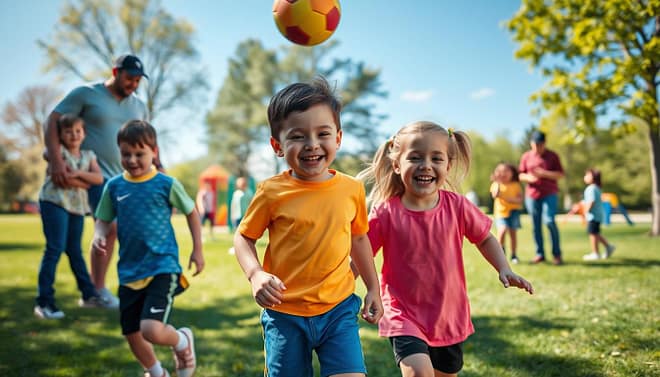
Bryan’s recreation programs focus on fun and inclusion. They welcome every child, no matter their skill level. Our sessions are designed to boost confidence.
Every small success is celebrated. Catching a ball or mastering a new skill is a big deal. This builds self-esteem.
We don’t just give out medals for showing up. We celebrate real achievements. The joy of trying and succeeding is what matters most.
On the field, it’s all about personal growth. Kids learn at their own pace, cheered on by everyone. It’s about mastering challenges, not beating others.
| Focus Area | Traditional Youth Sports | Beginner Sports Bryan Approach |
|---|---|---|
| Primary Metric | Winning & Score | Fun & Personal Effort |
| Confidence Source | Outperforming Others | Mastering New Skills |
| Coach’s Role | Strategist & Critic | Cheerleader & Guide |
| Error Handling | Corrected as Failure | Framed as a Learning Step |
| Long-term Goal | League Championship | Lifelong Love of Activity |
This approach makes kids resilient. They see mistakes as part of learning. It builds a supportive community, not just competition.
Fun makes kids fearless. Without fear, they explore and learn faster. They gain confidence in teams and with their bodies.
Bryan’s youth programs focus on happiness and confidence. It’s not about winning. It’s about creating active, happy kids. The goal is to make them want to play again next week.
Benefits of Early Introduction to Sports
Introducing toddlers to sports at a young age offers numerous benefits. It helps in developing their physical skills, such as balance, coordination, and strength. These skills are essential for their overall health and well-being.
Engaging in sports also promotes cognitive development. It enhances their problem-solving abilities, memory, and concentration. These skills are vital for their academic success and personal growth.
Participating in sports fosters social skills and teamwork. Toddlers learn to communicate effectively, work together, and develop empathy. These skills are essential for building strong relationships and achieving success in various aspects of life.
Playing sports helps toddlers develop a positive mindset and self-confidence. It encourages them to try new things, take risks, and overcome challenges. This mindset is essential for their personal growth and development.
By introducing toddlers to sports early, parents can provide them with a solid foundation for a healthy and fulfilling life. It is important to choose age-appropriate sports and ensure a safe and supportive environment for their development.
Benefits of Early Introduction to Sports:
- Develops physical skills such as balance, coordination, and strength
- Enhances cognitive development, including problem-solving abilities, memory, and concentration
- Fosters social skills and teamwork
- Encourages a positive mindset and self-confidence