Let’s be honest. Most sports academies sell you a polished fantasy.
They promise transformation through glossy brochures and generic mission statements. But what if the real magic isn’t in the program, but in the people running it?
Forget clipboard-wielding automatons. The heartbeat here is something else entirely. It’s in individuals like Ron Washington.
His journey reads like a cultural blueprint. From the Desire projects of New Orleans to a ten-year MLB career, then managing the Rangers and snagging a World Series ring with Atlanta. That’s not just a resume; it’s a masterclass in turning adversity into advantage.
This story isn’t an anomaly. It’s our overture. It frames what makes this coaching staff different. We’re not just talking about baseball. We’re talking about the narratives, the scars, and the hard-won wisdom they bring to the field.
Coaching Credentials and Experience
What does a 52-year career in professional baseball teach about mentoring a 12-year-old? Everything and nothing you’d expect. A resume isn’t just a list of jobs. It’s a story of survival and growth, showing a coaching philosophy shaped by intense experiences.
Take Ron Washington as an example. His decade in the MLB wasn’t glamorous. It was a lesson in survival. He learned the game from the ground up, gaining a unique perspective.
Washington’s coaching career began with the Mets and Athletics in the 90s and 2000s. He wasn’t just teaching footwork. He was breaking down the DNA of elite infielders. He transformed raw talent into Gold Gloves, sharpening his analytical skills.
Then, he became a manager. Leading the Texas Rangers to two World Series appearances was a huge challenge. It taught him how to handle high-pressure situations and manage millionaire players.
Even now, as the third base coach for the Atlanta Braves, he continues to grow. His role in the 2021 World Series win shows his dedication to learning and adapting. It’s not just a job; it’s a lifelong passion.
So, what’s the key takeaway? A coaching philosophy shaped by top-level experiences. It’s not just theory; it’s practical and proven. Players learn from a living legend, not just a manual.
What Sets Coaches Apart
The ‘Wash Regimen’ isn’t found in a drill book. It’s a philosophy, a daily drip of belief that turns failure into firmware. Any competent technician can teach a child the hardware of a swing—the grip, the stance, the rotation. But the elite youth baseball coaches install the software.
We’re talking about the intangible operating system. Ron Washington’s personal code is famously simple: “Dedication and belief.” It sounds like a motivational poster. Until you see it in action. His view of failure isn’t as a tombstone, but as a temporary roadblock—a “learning experience” packed with data for the next repetition.
How does a man who came one pitch away from a World Series title translate that agony to a 12-year-old who just booted a ground ball? He reframes the entire game. The error isn’t an end; it’s a single line of code in a much longer program. The coach’s job is to debug it, not delete the player.
This is where the sage separates from the instructor. Washington’s reputation as an enthusiastic, positive teacher isn’t an act. It’s a strategic tool. That energy is the same for a wide-eyed seven-year-old as it was for a major league All-Star. Why? Because belief is non-negotiable, and enthusiasm is its delivery mechanism.
Then there’s the gritty realism of routine. His time with the Braves is legendary for consistency—”you could set your watch by it.” This is the other half of the secret sauce. Positivity without structure is just cheerleading. The magic is in the blend: unwavering optimism housed within a framework of relentless, predictable work.
So, what truly sets these coaches apart? Consider this breakdown:
- The Philosopher: They sell a worldview where effort beats talent when talent doesn’t work hard.
- The Translator: They convert complex, high-stakes concepts (like dealing with crushing defeat) into simple, digestible lessons for kids.
- The Energizer: Their positivity isn’t conditional on success; it’s the default setting, creating a safe space to fail and learn.
- The Architect: They build a daily routine so solid that a player’s confidence can grow within its walls.
The best youth baseball coaches understand that they are not just training athletes; they are coding resilience. They know the swing will come and go. The belief system they install—that dedication is the price of admission, and failure is just feedback—that lasts long after the season ends. That’s the upgrade no manual can provide.
Personalized Mentoring
Imagine a coach who sees more than just a bad swing. They see the story behind it. This is what makes the Rangers Academy special. We believe every kid is unique, not just another player.
Ron Washington is a great example. He doesn’t just coach; he understands each player deeply. He sees beyond the surface, helping players grow. Washington’s own story, like throwing against a wall, shows the power of repetition and personal effort.
Our coaching philosophy is all about personal attention. We find the mechanical and mental issues each player faces. It’s not just about fixing a flaw; it’s about understanding it.
We create a plan that’s just right for each player. It’s a mix of skill-building and confidence-boosting. This approach is not one-size-fits-all. It’s tailored to each player’s needs.
So, what does this look like in practice? Let’s break it down:
- The Diagnostic: We start with a detailed assessment. We look at body language, how they react to failure, and their team interactions.
- The Narrative: Coaches like Washington use stories to make lessons stick. They connect the skill to a personal experience.
- The Prescription: We create a plan with drills for both technique and mindset. It might be footwork for one player or visualization for another.
This approach is the opposite of the assembly line. It takes more time and effort. But the result is a player who truly understands their skills. They build confidence through personal achievements, not just praise.
This is the heart of our coaching philosophy. It’s not just a slogan. It’s a deep conversation between coach and player, finding the best path for each player. In a world of mass production, we create unique individuals.
Parent-Coach Communication
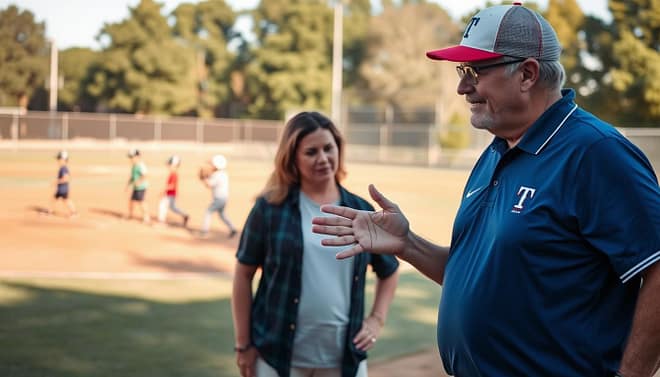
Our academy believes that being available leads to clear communication. This isn’t just a theory. It’s how we operate, inspired by the professional world. Our youth baseball coaches see themselves as partners, not just authority figures. They work together with parents to help your child grow.
Imagine the relationship between a general manager and a sports reporter. But instead of cynicism, there’s a shared goal. The coach is like the GM, handling the team and strategy. You’re the reporter, wanting to know the story behind the game.
Good communication turns a minefield into a partnership. Coaches explain complex ideas in simple terms. They help parents understand and support their child’s growth.
- Radical Transparency: Every decision about your child’s playing time is explained. Our coaches connect today’s choices to future skills.
- Expectation Management: We set clear goals from the start. Is it a college scholarship or just loving the game? Honest talks prevent later misunderstandings.
- The United Front: Coach and parent work together in front of the player. Disagreements are kept private to protect the child’s confidence.
Being a stakeholder, not just a spectator, is key. For more tips on working with coaches, check out these strategies for effective communication. When parents and coaches work together, the player benefits every time.
Stories from the Field
Forget the spreadsheets. The real magic of this coaching philosophy unfolds in the dirt and grass of the academy’s diamonds.
Data gives you the what. But these stories? They give you the why. They’re the unscripted, human moments no metric can capture.
Take the holiday season. While most of us are deep in gift-wrap and eggnog, one coach’s schedule is different. “You know, you always come around Christmas break,” a staffer shared. “Which is our Christmas present, right as a staff, because we know Wash is coming in.”
Think about that. His arrival isn’t an obligation. It’s a gift. That’s the kind of enthusiasm that defines the place.
And it doesn’t scale based on the player’s age or skill. The same staffer observed, “He has as much enthusiasm when he’s out here working with a seven or eight year old than anyone is working with Von Grissom.”
Let that sink in. The energy for a beginner is identical to the energy for a pro. What does that teach a kid? You matter. Right now.
Then there’s the breakthrough. Picture a player, hesitant, stuck in a loop of missed swings. The technical fix is simple. The mental block? That’s the real game.
A coach explains the concept. Again. And again. The tenth explanation uses a different analogy—a car turning a corner, a door swinging open. Suddenly, the kid’s eyes widen. The connection is made.
This isn’t a fairy tale. It’s a case study in applied coaching philosophy. Belief met repetition and produced a tangible, human result.
The most powerful stories aren’t about home runs. They’re about seeing a path forward. Another anecdote drives this home: “They can look at him and see, okay, I do have a path.”
That moment of clarity is everything. It transforms doubt into direction. It turns practice from a chore into a journey.
So, what’s the common thread in these field stories? It’s a philosophy that values the person over the player. It’s patience worn not as a burden, but as a tool. It’s showing up—during the holidays, for the tenth explanation—because the when and how many times are irrelevant.
The scoreboard fades. The stats blur. What remains is the look on a kid’s face when they get it. That’s the trophy. That’s the story.
And that story is the ultimate proof of a coaching philosophy that works. Not in theory, but in the cleat-marked, sun-baked reality of the field.
Advice for Parents
In today’s world, youth sports are a mix of talent and no patience. Ron Washington, a wise coach, said something important. He noted, “These young kids have all of this talent… and we don’t have enough patience to allow them to be what they will be with time, which is experience. Experience is only something you get by going through it.”
We live in a time where knowledge is just a click away. But experience is different. It’s gained through trying and failing. Our youth baseball coaches ask parents to watch and learn, not just direct.
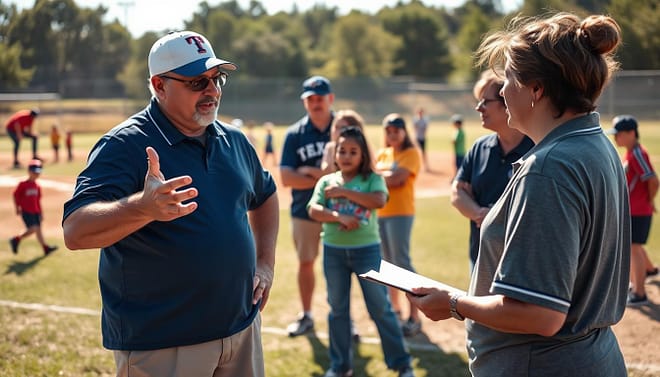
The biggest advice isn’t about fixing swings. It’s about being present. Stop recording every play. Watching live is more valuable than any video.
This is a big problem today. We think knowing a lot means we’re wise. But, watching videos doesn’t teach a kid to hit a curveball in a real game. That takes practice and trying again.
So, what should parents do? They should support their kids without taking over.
How to support without smothering: Ask questions instead of telling. “What did you see on that pitch?” is better than “You should have swung earlier.” Let your child think for themselves.
How to encourage without applying crippling pressure: Focus on the effort, not just the result. Cheer for the hard play, even if it’s not a win. The goal is to build character, not just win games.
How to trust the process: Coaches work hard to teach skills. Their programs are designed to help kids grow over time. Trusting them means accepting failures as part of learning.
To make it simple, let’s look at what parents usually do.
| Parental Behavior | Stated Intention | Actual Impact | Coach’s Verdict |
|---|---|---|---|
| Recording Every Moment | Preserving memories, analyzing play. | Creates performance anxiety; child plays for the camera. | “Be a fan, not a film crew.” |
| Offering Unsolicited Tips Post-Game | Helping them improve faster. | Undermines coach’s authority; overwhelms the player. | “Let us coach. You parent.” |
| Focusing Solely on Wins & Stats | Teaching competitiveness. | Reduces the game to a transaction; kills joy. | “Development is the long game. The scoreboard is a snapshot.” |
| Trusting the Process & Observing Quietly | Providing unconditional support. | Fosters a safe space for risk-taking and learning. | “This is the way. You are our greatest ally.” |
This table is not to shame. It’s to help parents understand their role. The best youth baseball coaches need parents who are patient and supportive. Patience is key to helping kids grow.
Enjoy the game, good and bad. Cheer for every play. Your child’s journey is about learning and growing, not just winning. Watching from the sidelines, with your phone away, is rewarding.
Conclusion: The Academy’s Coaching Difference
So, what’s the final score? It’s not about new gear or magic drills. It’s about the people in the dugout.
Ron Washington once said, “Manager. Coach. Mentor. Positive influence.” That’s the Texas Rangers Academy’s secret. It’s led by baseball lifers who love learning more about the game.
This approach mixes experience with deep understanding. It’s not just about hitting. It’s about learning from mistakes. The academy offers a personal touch and talks openly with parents, helping players grow.
Choosing this academy means more than just drills. It connects your child to a legacy of wisdom. The most valuable lesson might not be a perfect swing. It could be the resilience and outlook gained from facing failure.
The true coaching philosophy here is that the right guide makes all the difference. The game teaches a lot, but the right mentor can change everything.