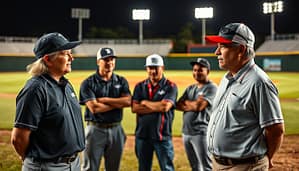
For over 15 years, we’ve changed how young athletes grow. We ditched the old drill sergeant style. Now, we focus on making baseball thinkers.
Our method is simple yet powerful. We see player development as compound interest. It grows fast, not slow.
When a player’s mechanics and mental game come together, it’s not magic. It’s science.
Top Prospects Academy is more than a place. It’s a lab for growth. Here, top training meets quality teaching, boosting skills fast.
We don’t just make players. We create competitors who think deeply about the game. Real growth happens when you start solving problems, not just following rules.
Age Group Breakdown
Some programs treat youth coaching like a one-size-fits-all solution. But we create personalized plans for every age. With over 40 teams from 9u to 18u, we know how to tailor development.
Our coaching team is like a specialized medical team. Each coach works with the right age group. Braden McIntire works with our youngest players (9u and under), teaching the basics.
Joseph Mulcahey guides 9U-12U hitters in “operating system installation.” It’s not just about swing mechanics. It’s about coding muscle memory for life. The right form at this stage means fewer problems later.
Spencer Pellegrini’s pitching program is for 11U-18U players. Here, we move from teaching mechanics to developing artists. It’s like moving from paint-by-numbers to creating original art.
Dakota Branger teaches 9U-14U catchers. This is where we build the game’s quarterbacks. They’re not just catching pitches; they’re learning to control the game.
Each age group faces unique challenges. A 9-year-old needs different youth coaching than a 16-year-old. It’s all about matching the right techniques to the right age.
Our approach is like building a skyscraper. Each floor needs its own plan and materials. The foundation work with young players supports the advanced work with teens.
This specialized youth coaching ensures every player gets what they need. No more forcing players into the wrong roles. It’s about development that makes sense.
The result? Players grow with baseball, not just learn it. Their skills match their physical and mental growth. It’s youth coaching that truly works.
Individual Skill Clinics
Ever wonder what happens when you mix a baseball field with a research lab? Welcome to our skill clinics. Here, athleticism meets analytics in a delicious way.
We’ve put together a team of coaches who are baseball’s superheroes. Each one has special skills from college and pro games. They don’t just teach skills; they unlock athletic secrets.
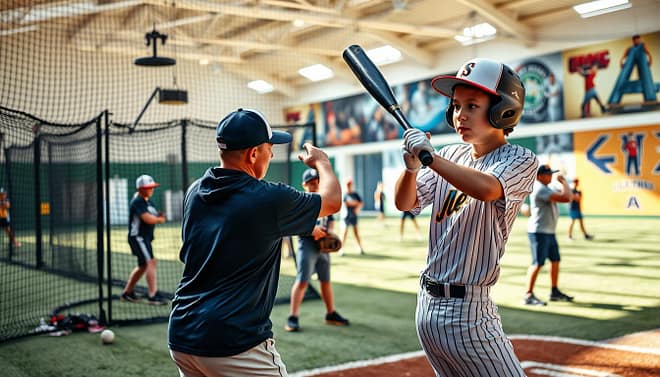
Spencer Pellegrini’s pitching clinics turn throwing into physics. He teaches how to use torque and leverage in fastballs. It’s like a masterclass in biomechanics with a hint of intimidation.
Joseph Mulcahey looks at hitting like a jazz musician analyzes music. His sessions break down the swing into rhythmic parts. It’s like finding harmony between power and precision in music.
Dakota Branger’s catching lessons make players into field generals. He teaches them to read the game like chess masters. The best catchers orchestrate the defense, not just catch pitches.
Marcos Sanchez brings infield skills that would impress Ozzie Smith. His knowledge in hitting and infield helps players understand how skills work together.
Boston McIntire’s group lessons turn individual brilliance into teamwork. Players learn that teamwork amplifies individual skills through coordination.
| Coach | Specialization | Playing Background | Teaching Philosophy |
|---|---|---|---|
| Spencer Pellegrini | Pitching | Collegiate/Professional | Biomechanical optimization |
| Joseph Mulcahey | Hitting | Collegiate/Professional | Rhythmic mechanics analysis |
| Dakota Branger | Catching | Collegiate/Professional | Strategic game management |
| Marcos Sanchez | Hitting & Infield | Collegiate/Professional | Dual-skill integration |
| Boston McIntire | Group Lessons | Collegiate/Professional | Collective skill synthesis |
The magic is in our skill progression method. We’ve created a ladder for players to climb. Each step shows clear improvement, no guessing.
Our coaches teach from real experience, not books. They’ve won games and have the scars to prove it. They know how to hit with runners on base from actual games.
Our system keeps players growing. Each session builds on the last, adding to their skills. It’s like upgrading their athletic software every week.
This isn’t just practice; it’s a focused journey to greatness. It turns good players into legends.
Parent-Player-Coach Communication
Have you ever seen a parent trying to talk to a coach while their kid looks uncomfortable? It’s a common sight. At Stix, we know communication is key. Without it, everything falls apart.
Parents are the emotional support, players receive information, and coaches guide them. It’s a balance that needs supportive coaching at every step.

We’ve seen how poor communication can hold back athletes. But those who can talk well often do better, even if they’re not the most skilled. It’s like having a sports car with GPS versus one without.
Our success in college placement isn’t just about skills. It’s about being able to communicate and follow directions. The best athletes are those who understand the game beyond just playing it.
Supportive coaching means helping athletes grow, even outside of practice. It’s about making sense of the chaos. Talent needs direction to truly shine.
We’ve learned the hard way that good communication is possible in youth sports. It’s all about paying attention to all three parts of the communication triangle.
Seasonal Growth Tracking
Our tracking system is like the Moneyball approach in baseball. We focus on what really matters for success. If you can’t measure it, you can’t improve it, and we live by this rule.
We don’t just look at stats. We create a detailed plan for each player, chapter by chapter. We track physical and mental markers that show if a player is ready for college.
Those 30-35 college commitments we help with? It’s not luck. It’s the result of data-driven development. We track milestones that predict success, not just current performance.
Our tracking includes:
- Physical development metrics (velocity, bat speed, mobility)
- Technical skill progression (launch angle evolution, pitching mechanics)
- Mental game indicators (pressure performance, game awareness)
- Leadership development markers
Each season adds to a player’s journey. We can show how they’ve improved, why certain skills matter, and what they need to work on next. It’s about proving improvement with data, not just saying it.
This method needs experts. That’s why we’re always looking for top talent to join our coaching and development team. The right people make the data come alive.
Our growth milestones are based on proven indicators. They show if a player is ready for college or more. When we say a player is on track for Division I, we’re not guessing. We’re reading the data story from season to season.
The result? A clear development roadmap that even the most skeptical parents believe in. Seeing real growth milestones achieved is more convincing than any sales pitch.
Success Stories
Proof is in the pudding, or in our case, college commitment letters. Stix has placed 30-35 players in college programs every year. These stories are real-life examples of how player development works.
Our coaches are living proof of success. Spencer Pellegrini, Joseph Mulcahey, and Dakota Branger are not just teachers. They are former players who now help others achieve their goals through player development.
Think about the pitcher who got 8 mph faster with new mechanics. Or the hitter who turned his swing into real power. Or the catcher who learned to control games like a pro. These are not just stories. They are the results of our approach.
The Stix story is about making opportunities through player development. It’s about changing lives and opening doors. Our approach has proven to work where it counts most.