Let’s get real. Most youth sports training is like throwing spaghetti at the wall. You see dads in driveways, kids doing generic drills, and everyone just hoping it works. It’s a huge industry based on chance.
Today, it’s all about guessing. Players spend a lot on lessons without knowing their true level. This is a big mistake in development. Good coaching means using facts, not hopes.
That’s where baseline testing comes in. It’s not just for top athletes. It’s the heart of putting athletes first. It helps create a safe place, real growth, and character through clear feedback for training.
We’re moving from myths to facts, from worry to a plan. It’s the shift from buying a lottery ticket to having a blueprint. The test gives clarity, direction, and accountability. In youth sports, knowing is powerful—it’s everything.
Testing Menu: Movement Screen (Hips/Shoulders), Sprint/Agility, Jump Profile, Throwing Velo/Command, Bat Speed/EV
Our playbook isn’t just a number; it’s a detailed menu for young athletes. It’s like a full diagnostic test. Each part tells a unique story.
First, we check the movement screen. This ensures the hips and shoulders are aligned. It’s like building a race car from scratch. Without it, you’re just fixing problems.
Next, we test raw athleticism with sprint/throw metrics. Baseball is all about quick, explosive movements. A fast 60-yard dash and quick changes of direction are key.
Then, we examine the jump profile. Vertical leap shows lower-body power and elastic energy. It’s vital for a pitcher’s drive and a hitter’s power.
Now, we focus on velocity testing with radar guns. We measure throwing speed and accuracy. A fast, accurate fastball is more valuable than a slow, wild one.
On offense, we look at bat speed and exit velocity (EV). We want to see EV numbers rise. But it’s about hitting hard and controlled, not just fast.
This menu helps players throw faster, hit harder, and improve accuracy. It turns data into a plan. With this plan, you can create fun baseball drills to improve key skills.
The goal is to understand the connections between different skills. It’s about building a ballplayer, not just testing them.
Protocols and Safety: The Unseen Framework of Good Data
Think of baseline testing as a pre-flight checklist for athletes. Skipping a step can lead to trouble. Data is powerful, but collecting it carelessly can cause harm.
Let’s talk about the warm-up. You wouldn’t ask a Ferrari to start without warming up. Athletes need a proper warm-up before pushing their limits. It prepares their body for action.
Our warm-up routine is key. It starts with exercises for the hips and shoulders. Then, we do light jogging and mock throws. This gets the body ready and safe for testing.
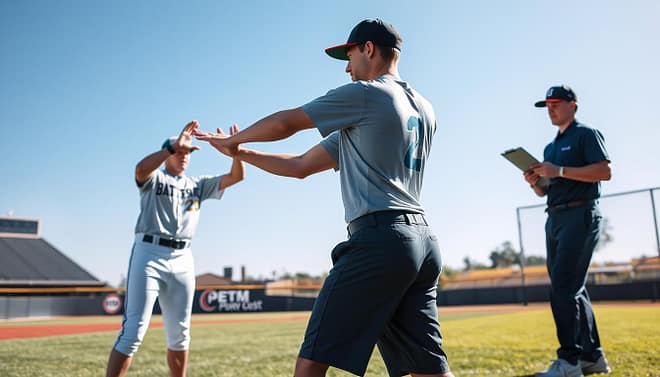
Next, we focus on radar gun placement. The right spot can make a big difference in readings. Wrong placement can skew results, affecting an athlete’s confidence.
Here are tips for accurate readings. Place the radar gun behind the catcher, in line with the pitcher. Make sure it has a clear view of the ball. Use the same model every time for consistent results.
Privacy is also important. Testing can be tough for young athletes. Coaches should keep the focus on the athlete’s growth, not just numbers.
Creating a safe space is key. Talk positively and keep the focus on growth. This approach helps athletes see testing as a chance to improve, not just to be judged.
Good protocols make testing valuable. They ensure safety, accuracy, and respect. This builds trust and gives useful data.
How to log data and set realistic targets by age/level
Your spreadsheet is now a mosaic of numbers, but without a map, it’s just colorful confusion. This is where the art of data logging separates the pros from the amateurs. It’s not about filling cells; it’s about writing a biography.
Think of each entry as a chapter in your athlete’s story. A dip in vertical jump isn’t just a lower number. Was it a poor workout, or did he stay up until 2 AM acing an algebra final? You need a system that captures the full narrative.
I advocate for a simple, consistent method—digital app or old-school notebook. Track your core sprint/throw metrics, but also log the co-stars:
- Sleep quality and hours
- Perceived stress (school, social)
- Session effort on a 1-10 scale
- Even dietary notes (that post-game pizza feast matters)
This context turns a data point into a diagnosis. Now, for the minefield: goal setting. The cardinal sin is aiming for the moon with a slingshot. Telling a 12-year-old to “add 10 mph” is a recipe for injury and despair.
You must set realistic targets. This is where a benchmarking with Rapsodo mindset pays off. Use the SMART framework—Specific, Measurable, Achievable, Relevant, Time-bound.
For a young player, “get stronger” is a wish. “Increase lower-body power to add 2 inches to my broad jump in 8 weeks” is a target. This precision is what we mean by a Personalized Development Roadmap.
Your player’s age and competitive level are the master keys. A 14-year-old freshman aiming for JV has a fundamentally different path than a 17-year-old vying for a college spot. You must think in percentiles, not just raw numbers.
Here’s a pragmatic framework:
- Ages 10-12 (Late Childhood): Focus on movement literacy and fun. A realistic target is consistent improvement in movement screen scores. Velocity gains are a bonus, not the goal.
- Ages 13-15 (Early Adolescence): Growth spurts rule. Targets should stabilize new strength. Aim for controlled improvements in bat speed or throwing command, maybe 3-5% over a training block.
- Ages 16-18 (Late Adolescence): Specialization intensifies. Realistic targets here align with collegiate or elite high school benchmarks. Adding 1-2 mph to a fastball in a season is a major win.
This tailored approach is the soul of a true Follow-Up Consultation. It’s not a generic plan. It’s a set of recommended training, class options, or at-home workouts built for your player’s stage.
So, stop staring at the glowing spreadsheet. Start building the roadmap. Log the context, set the smart goals, and watch the biography of a ballplayer unfold—one realistic chapter at a time.
Translating results into training blocks
Data from baseline tests is like a treasure map—X marks the spot where your training should dig. This is the alchemy. We’re turning leaden numbers into golden progress. The first source promises a “custom outline,” and that’s exactly what we deliver. No more guesswork. No more wandering in the desert. You’re following a GPS.
So, your player’s report is in. Now what? You can’t attack every weakness at once. That’s a recipe for burnout and mediocre gains. You must triage. What’s the single biggest thing holding them back? Is it stiff hips robbing throwing velocity? Is low bat speed capping their power?
Identify the biggest limiter. Then, look for the low-hanging fruit. Maybe their jump profile shows great force but lousy rate of force development. Fixing that could yield a quick confidence boost. Quick wins build belief in the process. They turn skeptics into believers.

Once you’ve prioritized, you design training blocks with ruthless intent. The data dictates the focus. If the movement screen reveals a glaring hip mobility issue, the next 8-week block isn’t about more throwing. It’s dedicated to unlocking that range of motion. If bat speed is low but strength scores are high, the problem is likely technical, not physical. The block becomes “Skill Refinement,” not “More Weightlifting.”
Here’s how to break it down into actionable phases. Think of these as seasonal TV arcs for your athlete’s development.
| Training Block Type | Primary Focus | Key Exercises & Drills |
|---|---|---|
| Hypertrophy & Mobility | Building foundational muscle, correcting asymmetries, increasing joint range of motion. | Goblet squats, TRX rows, hip CARs (Controlled Articular Rotations), shoulder capsule stretches. |
| Power & Speed | Translating strength into fast, explosive movements for sprinting, jumping, and swinging. | Medicine ball throws, plyometric box jumps, resisted sprint starts, overload/underload bat drills. |
| Skill Refinement | Polishing technical execution in throwing mechanics, swing path, and pitch command. | High-speed video analysis, dry reps with focus on kinetic sequence, target-based throwing drills. |
This table isn’t just a suggestion box. It’s a direct prescription from the diagnostics. See a low vertical jump but good mobility? That’s a Power & Speed block. Notice wild command despite high velocity? That’s a Skill Refinement block, maybe with a side of mental focus work.
The magic of translating results this way is the elimination of noise. You’re not just working hard; you’re working right. Every sprint, every lift, every swing has a purpose tied directly to a metric you need to move. It’s the difference between shooting arrows in the dark and hitting a bullseye under bright lights.
Your player’s data has spoken. Now, it’s time to build the plan that answers back. This is how you turn testing from a mere snapshot into a blueprint for dominance.
Retest cadence and interpreting plateaus
Think of your initial baseline testing baseball report as a pilot episode. The real story unfolds in the sequels. A smart retest cadence turns data points into a compelling series.
I recommend a new assessment every 6-8 weeks for in-season tweaks. For off-season transformation blocks, aim for a 12-16 week retest cadence. This rhythm transforms guesswork into a plotted narrative.
Here’s the plot twist every story needs: the plateau. Your athlete’s graph will flatline. Interpreting plateaus is where coaching artistry meets science. Is it a true physiological ceiling, or just program boredom? Has life stress spiked? Maybe the training stimulus went stale.
That optional secondary assessment? Frame it as a strategic director’s meeting, not a performance review. It’s a tool for interpreting plateaus with curiosity, not panic.
Communicate this to players and parents. A plateau is a data point demanding a new question, not signaling failure. Development, like any good saga, has its own pacing. Your retest cadence is how you read the chapters.